Receiving a Chevening interview invitation is a major achievement. It means your written application passed a highly competitive review stage and the panel now wants to meet the person behind the essays.
But the interview is not just a formality.
The Chevening interview is one of the most important stages of the selection process. It is where the panel tests whether your leadership story, networking ability, UK study plan, and career goals are authentic, realistic, and strong enough for a fully funded UK government scholarship.
This guide explains the Chevening interview process, common Chevening interview questions, sample answer structures, preparation tips, documents required, interview mistakes, and what to expect after the interview.
If you are still preparing your full application, start with our complete guide to Chevening Scholarship requirements.
What Is the Chevening Interview?
The Chevening interview is a competency-based panel assessment conducted in English.
It is designed to evaluate whether you match the qualities Chevening looks for in future leaders.
The panel will usually ask about:
- Your leadership and influence experience
- Your networking ability
- Your selected UK courses
- Your career goals
- Your personal and professional aspirations
- Your expected contribution to your home country
- How Chevening can help you create impact
Your interview is closely connected to your original application. The panel may ask you to explain, expand, or defend what you wrote in your essays.
That is why you should carefully reread your Chevening essays before the interview.
Internal link: Chevening Scholarship Essays Guide
Chevening Interview 2026 Timeline
For the 2025–2026 Chevening cycle, interviews take place from March to April 2026.
Here is the official interview-related timeline:
| Stage | Date |
|---|---|
| Interview shortlist announcement | Mid-February 2026 |
| Interview period | March to April 2026 |
| Document upload deadline | At least seven working days before interview |
| Interview results | From mid-June 2026 |
| UK university offer deadline | 9 July 2026 |
If you want the full application schedule, read our Chevening Scholarship Timeline guide.
What to Expect During the Chevening Interview
A typical Chevening interview is formal but usually friendly. The panel is not there to trick you. They want to understand your story, test your preparation, and see whether you can clearly explain your goals.
Interview Format
| Interview Detail | What to Expect |
|---|---|
| Language | English |
| Type | Competency-based panel interview |
| Panel | British embassy/high commission representatives and sometimes Chevening-related representatives |
| Duration | Often around 30–60 minutes |
| Location | Confirmed after booking; may be in person or virtual depending on country |
| Focus | Leadership, networking, UK study plan, career goals, and application details |
Some candidates report interviews lasting around 20–30 minutes. Others may have longer interviews. A shorter interview does not automatically mean rejection, and a longer interview does not automatically mean success.
The quality of your answers matters more than the number of minutes.
What Documents Are Required Before the Chevening Interview?
Candidates invited to interview must complete required pre-interview tasks.
You may need to upload:
- Passport or national ID card
- Undergraduate education certificate or diploma
- Two reference letters
- Any missing documents requested in the interview invitation
You should also bring your official photo ID to the interview.
Do not wait until the last few days. If your reference letters, degree certificate, or ID upload has a problem, you may face unnecessary stress.
For full document details, read our Chevening Scholarship Requirements guide.
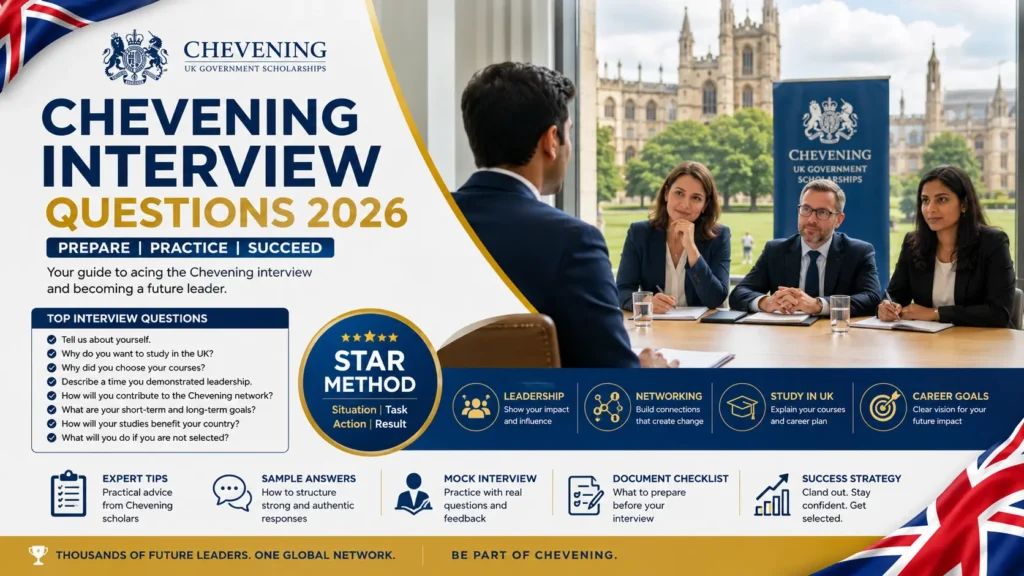
Top Chevening Interview Questions 2026
Below are common Chevening interview questions based on official guidance, alumni experiences, Reddit discussions, and applicant reports.
These are not guaranteed exact questions, but they represent the main themes you should prepare for.
1. Tell us about yourself.
This is often used as an opening question.
The panel is not asking for your full life story. They want a clear, confident introduction that connects your background to Chevening.
How to answer
Keep it around 90 seconds to 2 minutes.
Mention:
- Your professional background
- Your leadership area
- Your main achievement
- Your chosen field of study
- Your future goal
- Why Chevening fits your plan
Sample structure
“My name is [Name], and I work in [sector/role]. Over the past [number] years, I have focused on [area of work]. One of my most meaningful achievements was [specific impact]. I am applying for Chevening because I want to study [course/field] in the UK and return to [country] to address [specific problem]. My long-term goal is to [career vision].”
2. Why did you apply for Chevening?
Do not say only “because it is fully funded.”
Chevening is not just about money. It is about leadership, networks, UK education, and long-term impact.
Strong answer points
- Chevening matches your leadership goals
- The UK offers relevant academic expertise
- The Chevening network can support your long-term impact
- You want to return home and contribute to your sector
- The award will accelerate your professional development
Weak answer
“I applied because Chevening covers tuition, flights, and living expenses.”
Strong answer
“I applied for Chevening because it combines academic training, leadership development, and a global professional network. My goal is to strengthen public health data systems in my country, and Chevening will help me gain both the technical knowledge and international networks needed to do that effectively.”
3. Why do you want to study in the UK?
This question tests whether you understand why the UK is the right place for your master’s degree.
Avoid generic answers like “the UK has the best universities.”
What to include
- UK academic strengths in your field
- Practical teaching approach
- One-year master’s structure
- Relevant research centres
- Professional networks
- UK experience connected to your country goals
Sample answer
“I chose the UK because its universities offer strong one-year master’s programmes in policy, governance, and development. The courses I selected combine academic theory with applied policy analysis, which matches the skills I need. I also want to learn from the UK’s experience in evidence-based public policy and adapt relevant lessons to my country’s education sector.”
Internal link: Chevening Scholarship Courses Guide
4. Why did you choose these three UK courses?
This is one of the most important Chevening interview questions.
The panel wants to know whether your course choices are strategic or random.
Prepare for each course
For each of your three courses, know:
- Course title
- University name
- Key modules
- Why the course fits your career goals
- Specific skills you will gain
- How it connects to your home country impact
- Any relevant research centre, professor, or teaching method
Strong answer formula
“I chose [course] at [university] because it offers [specific module/skill/research area]. This directly supports my goal of [career goal]. For example, the module on [module name] will help me develop [skill], which I need to address [problem] in [country].”
5. Tell us about a time you demonstrated leadership.
This is a core Chevening interview question.
Do not define leadership. Demonstrate it.
Use a real example with measurable impact.
STAR Method
Use:
- Situation
- Task
- Action
- Result
Sample answer structure
“In my role as [role], I noticed [problem]. My responsibility was to [task]. I led [specific action], coordinated [people/stakeholders], and introduced [solution]. As a result, [measurable outcome]. This experience taught me [lesson], and it shaped my future goal of [career plan].”
6. What type of leader are you?
This question tests self-awareness.
Avoid saying “I am a born leader” or “I am a democratic leader” without examples.
Strong answer points
- Your leadership style
- Evidence from experience
- How you adapt to people and situations
- What you learned from leading others
Sample answer
“I would describe myself as a collaborative and outcome-focused leader. I believe in listening first, understanding people’s strengths, and then aligning the team around a measurable goal. In my recent project, I coordinated colleagues from three departments and created a shared work plan that reduced delays by 30%.”
7. Tell us about a time you failed.
Chevening is not looking for perfection. The panel wants to see honesty, learning, and resilience.
How to answer
Choose a real failure, but not one that damages your credibility.
Explain:
- What happened
- What you learned
- What you changed
- How you improved later
Sample answer
“In one project, I underestimated how much time community consultation would take. As a result, our first implementation phase was delayed. I learned that stakeholder mapping must happen before planning deadlines. In my next project, I built a consultation phase into the timeline and we completed the work ahead of schedule.”
8. What is networking, and why is it important?
Chevening cares deeply about networking.
Do not define networking as simply “meeting people.”
Networking means building meaningful professional relationships that lead to shared learning, collaboration, and impact.
Strong answer
“To me, networking is the ability to build and maintain purposeful relationships that create value. It is not just about collecting contacts. In my work, I built a network of local NGOs, government officers, and youth volunteers to deliver a skills programme. That network helped us reach communities we could not have reached alone.”
9. Give an example of your networking skills.
Use a real story.
Include:
- Who you connected with
- Why the relationship mattered
- What you achieved together
- How the network continued
Sample answer
“When I was working on a women’s digital literacy project, I contacted a local university, a telecom company, and two community organisations. I proposed a shared training model where the university provided volunteers, the telecom company supported internet access, and community organisations mobilised participants. Through this network, we trained 320 women in six months.”
10. How will you contribute to the Chevening network?
This question is often answered weakly.
Do not say only “I will attend events.”
Be specific.
Strong answer points
- Share your professional expertise
- Connect scholars in your field
- Support future applicants
- Build country-level alumni initiatives
- Collaborate on social impact projects
- Promote UK-home country partnerships
Sample answer
“I will contribute to the Chevening network by sharing my experience in climate policy and connecting scholars working on sustainability projects. During my study year, I plan to participate in climate-related student societies and Chevening events. After returning home, I want to support future applicants through mentoring and collaborate with alumni on policy dialogues.”
11. What are your short-term and long-term career goals?
This is a key question.
Your answer must be specific.
Short-term goal
What you will do immediately after returning home.
Long-term goal
The broader impact you want to create in 5–10 years.
Sample answer
“My short-term goal is to return to my role in the education development sector and lead teacher training programmes focused on rural schools. My long-term goal is to work with provincial education authorities to design scalable teacher development policies that improve learning outcomes for under-resourced communities.”
Internal link: Chevening Scholarship Application Process
12. How will your UK education benefit your country?
This question tests Chevening’s return-home mission.
Connect your degree to a real problem in your country.
Strong answer formula
“Problem in my country + UK course skills + my role after returning + expected impact.”
Example
“My country faces a gap in evidence-based public health planning. The UK course will train me in health policy analysis and programme evaluation. After returning, I plan to work with public health institutions to improve data-driven decision-making, especially in maternal health programmes.”
13. What major challenge does your country face in your field?
Prepare current, specific issues in your sector.
Examples:
- Education inequality
- Climate adaptation
- Gender-based violence
- Unemployment
- Public health access
- Governance reform
- Digital transformation
- Energy security
- Food security
- Migration
- Peacebuilding
Your answer should show knowledge and solutions, not just problems.
14. How will Chevening help you achieve your goals?
Mention:
- UK academic training
- Leadership exposure
- Chevening events
- Alumni network
- Professional development
- International perspective
- Access to experts and institutions
Sample answer
“Chevening will help me by giving me access to a focused UK master’s programme, a global network of professionals, and leadership development opportunities. These will strengthen my ability to design practical solutions and build partnerships when I return home.”
15. Why should we select you?
This is your chance to summarise your value.
Avoid sounding arrogant. Be confident and specific.
Strong answer
“You should select me because my professional experience, leadership record, and future plan are strongly aligned with Chevening’s mission. I have already created measurable impact in [field], and the UK degree will help me scale that work. I am committed to returning home and using the knowledge and network to contribute to [specific national goal].”
16. What will you do if you are not selected?
This tests resilience.
Do not say your life will stop.
Strong answer
“If I am not selected, I will continue working toward the same career goal. I will strengthen my profile, continue contributing to my sector, seek feedback where possible, and apply again if eligible. Chevening would accelerate my plan, but my commitment to this work does not depend on one outcome.”
Internal link: Chevening Scholarship Success Rate
17. How do you handle people with different opinions?
This tests emotional intelligence and teamwork.
Use an example.
Sample answer
“In my team, we once disagreed about project priorities. I organised a meeting where each person explained their concern, then we mapped the options against our project goals. This helped us choose a solution based on evidence rather than personal preference.”
18. What challenges do you expect in the UK?
Good answers show maturity.
Possible challenges:
- Academic pressure
- Cultural adjustment
- Weather
- Budgeting
- Time management
- Being away from family
- Adapting to UK teaching style
Sample answer
“I expect the academic workload and adjustment to a new education system to be challenging. However, I plan to manage this by using university support services, building peer networks, and maintaining a clear study schedule.”
19. What will you do outside academics in the UK?
Chevening wants active scholars.
Mention:
- Chevening events
- Student societies
- Professional conferences
- Volunteering
- Cultural exchange
- Networking with experts
- Visiting institutions related to your field
20. Do you have any questions for us?
Always prepare thoughtful questions.
Good questions include:
- “What qualities have you seen in scholars who make the strongest contribution to the Chevening network?”
- “How can scholars best remain engaged with Chevening after returning home?”
- “Are there country-level alumni initiatives that I could support after my award?”
Avoid asking questions that are clearly answered on the official website.
Chevening Interview Questions by Category
Leadership Questions
Prepare for:
- Tell us about a time you demonstrated leadership.
- What is your leadership style?
- Tell us about a difficult decision you made.
- Describe a time you influenced others.
- Tell us about a failure and what you learned.
- What leadership skills do you still need to develop?
- Who is a leader you admire and why?
Networking Questions
Prepare for:
- What does networking mean to you?
- Give an example of how you used networking to solve a problem.
- How will you use the Chevening network?
- How will you contribute to the Chevening alumni network?
- Who do you need to connect with to achieve your goals?
- How have your networks helped your professional growth?
UK Study Questions
Prepare for:
- Why do you want to study in the UK?
- Why did you choose these universities?
- Why did you choose these courses?
- Why not study in your home country?
- What specific modules are important to you?
- How will your course help your career goals?
- What will you do if your preferred course is unavailable?
Career Plan Questions
Prepare for:
- What are your short-term career goals?
- What are your long-term career goals?
- How will your career benefit your country?
- What problem do you want to solve?
- How will Chevening help you create impact?
- What will you do after returning home?
- How does your past experience connect to your future plan?
Personal and Closing Questions
Prepare for:
- Tell us about yourself.
- What makes you different from other applicants?
- What is your biggest achievement?
- What is your biggest weakness?
- How do you manage pressure?
- What will you do if you are rejected?
- Do you have any questions for us?
How to Prepare for the Chevening Interview
1. Reread Your Application
Your interview is based heavily on your application.
Review:
- Leadership essay
- Networking essay
- Studying in the UK essay
- Career plan essay
- Course choices
- Work experience
- Referee information
The panel may ask you to explain anything you wrote.
2. Prepare Extra Examples
Do not rely only on the examples in your essays.
Prepare additional stories for:
- Leadership
- Teamwork
- Conflict resolution
- Failure
- Networking
- Community impact
- Professional achievement
This helps you answer follow-up questions without repeating the same example.
3. Use the STAR Method
For behavioural questions, use:
| STAR | Meaning |
|---|---|
| Situation | What was happening? |
| Task | What was your responsibility? |
| Action | What did you do? |
| Result | What changed because of your action? |
You can also add one more point: Reflection.
Reflection shows what you learned and how the experience shaped your future goals.
4. Research Your Courses Deeply
For each course, prepare:
- Course title
- University name
- Modules
- Skills you will gain
- Why the university fits your goals
- How the course connects to your country’s needs
Do not say only “because the university is highly ranked.”
5. Research UK Links to Your Field
A strong candidate understands why the UK is relevant.
Research:
- UK policy or research in your field
- UK institutions related to your sector
- UK-home country partnerships
- Recent developments in your industry
- Professional bodies or networks in the UK
6. Practise Mock Interviews
Mock interviews help reduce nerves.
Ask a mentor or friend to ask tough questions.
You can also record yourself answering questions and check:
- Clarity
- Length
- Eye contact
- Confidence
- Structure
- Repetition
- Weak examples
7. Prepare Your Questions for the Panel
Your final questions should show maturity and genuine interest.
Do not ask about basic funding details unless they are unclear.
Ask about contribution, network, alumni engagement, or leadership development.
What to Wear for a Chevening Interview
Dress professionally.
Business formal or smart professional clothing is safest.
For men, this may include:
- Suit or blazer
- Formal shirt
- Tie if appropriate
- Polished shoes
For women, this may include:
- Formal suit
- Blazer and blouse
- Professional dress
- Modest, comfortable formal wear
Your clothes should help you feel confident and serious.
Avoid distracting outfits, casual wear, or anything uncomfortable.
Chevening Interview Tips
Before the Interview
- Book your interview slot early.
- Upload documents before the deadline.
- Reread your essays.
- Research your courses.
- Prepare extra examples.
- Practise mock interviews.
- Plan your route or test your video setup.
- Sleep well before the interview.
During the Interview
- Greet the panel politely.
- Speak clearly.
- Listen carefully.
- Take a moment before answering.
- Use examples.
- Stay concise.
- Be honest.
- Do not pretend to know something you do not know.
- Show passion without exaggeration.
- Keep answers connected to Chevening’s mission.
After the Interview
- Do not overanalyse every word.
- Wait for official results.
- Continue progressing your university offers.
- Do not contact the embassy repeatedly about your result.
- Prepare documents in case you are selected.
Common Chevening Interview Mistakes
Avoid these mistakes:
- Memorising robotic answers
- Giving vague leadership examples
- Choosing weak course explanations
- Not knowing your own essays
- Talking too much without structure
- Ignoring the networking essay
- Giving unrealistic career goals
- Speaking negatively about your country
- Making claims you cannot support
- Arriving late
- Forgetting documents
- Asking weak final questions
Chevening Interview Results
For the 2026 cycle, scholarship candidates are informed of the outcome from mid-June.
Results may be released gradually. Receiving your result earlier or later than another candidate does not automatically indicate success or rejection.
If selected, you will need to continue completing Chevening tasks and secure at least one unconditional offer from a UK university by the required deadline.
If you are not selected, you can apply again in a future cycle with a stronger application.
Final Thoughts
The Chevening interview is your chance to bring your application to life.
The panel already knows your written application was strong enough to reach the interview stage. Now they want to see whether you can explain your story with clarity, confidence, honesty, and purpose.
Prepare deeply, but do not sound rehearsed. Know your essays, but do not memorise them word for word. Use examples, show impact, explain your UK study plan, and connect everything to your long-term contribution to your home country.
A strong Chevening interview is not about perfect English or perfect answers. It is about authenticity, leadership, preparation, and a clear vision for impact.
Frequently Asked Questions
What is the Chevening interview process like?
The Chevening interview is a competency-based panel assessment conducted in English. The panel asks about your application, leadership, networking, UK course choices, and career goals.
How long is the Chevening interview?
The interview length can vary. Many candidates report around 30–60 minutes, while some interviews may be shorter depending on the panel and country.
What questions are asked in a Chevening interview?
Common questions cover leadership, networking, studying in the UK, course choices, career plans, personal motivation, and contribution to your home country.
How do I prepare for a Chevening interview?
Reread your application, prepare extra examples, research your UK courses, practise mock interviews, use the STAR method, and prepare thoughtful questions for the panel.
Is the Chevening interview in English?
Yes. The Chevening interview is conducted in English.
Who is on the Chevening interview panel?
The panel includes representatives from the British embassy or high commission. Other Chevening-related representatives may also be involved depending on the country.
Do I need to prepare a presentation?
No. Chevening states that the interview is competency-based and does not require a presentation.
What documents should I bring to the interview?
You should bring your passport or another official photo ID. Your invitation will tell you if any additional documents are required.
Can the Chevening interview be online?
The location and format are confirmed when you book your interview slot. Depending on country and circumstances, interviews may be in person or virtual.
What should I wear for a Chevening interview?
Wear professional business attire. Choose clothing that is formal, comfortable, and appropriate for a scholarship interview.
How many people are selected for the Chevening interview?
The exact number varies by year and country. Only shortlisted applicants are invited after application review.
What is the Chevening interview success rate?
Chevening does not publish a fixed interview success rate for every country. Your chances depend on your interview performance, country competition, and available awards.
When are Chevening interview results announced?
For scholarship candidates, interview results are announced from mid-June onwards.
Will I be notified if I am rejected after interview?
Yes. Scholarship candidates are informed about the outcome of their interview.
What if I do not understand a question?
Politely ask the panel to repeat or clarify the question. It is better to clarify than answer the wrong question.
Should I memorise my answers?
No. You should prepare your examples and structure, but avoid sounding scripted or robotic.
Can I use the same examples from my essays?
Yes, but prepare additional examples too. The panel may ask for a different leadership or networking example.
What is the best method for answering Chevening interview questions?
The STAR method is effective for behavioural questions because it helps you explain the situation, task, action, and result clearly.
Do I need to know current affairs?
Yes. You should know current issues in your sector, your country, and how your chosen field connects to development and policy challenges.
What should I ask the panel at the end?
Ask thoughtful questions about Chevening’s network, alumni contribution, leadership development, or country-level engagement.
Can I apply again if I fail the interview?
Yes. Many applicants apply again in a future cycle after improving their essays, experience, course choices, and interview preparation.
Is a short Chevening interview a bad sign?
Not necessarily. Interview length alone does not determine the result. A short, focused interview can still be strong.
What is the biggest Chevening interview mistake?
The biggest mistake is giving vague, memorised answers without specific examples, measurable impact, or a clear career plan.