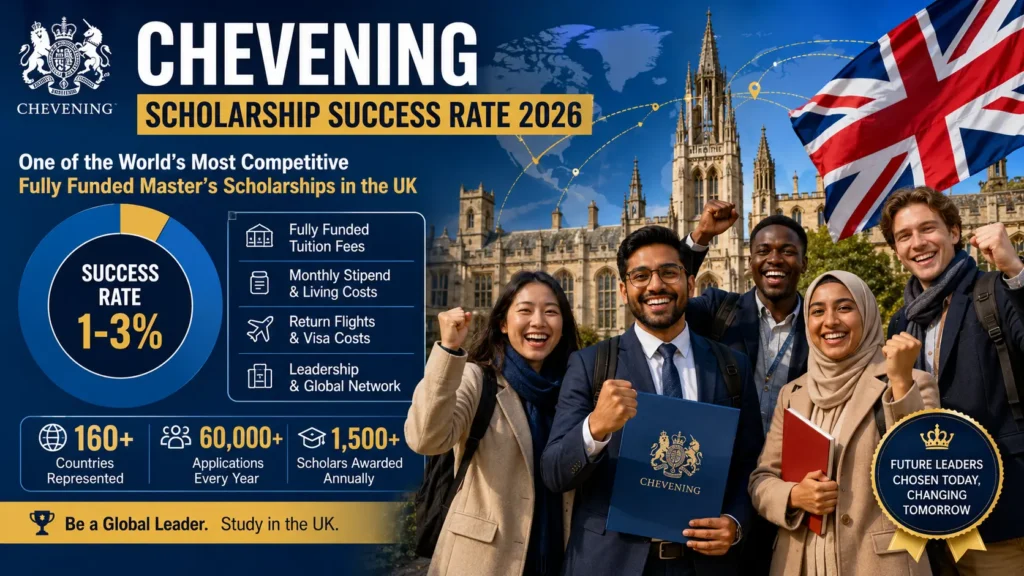
The Chevening Scholarship success rate is very low because Chevening is one of the most competitive fully funded master’s scholarships in the world. Official Chevening guidance states that only around 1% of applicants are eventually selected. Other public estimates often place the Chevening scholarship acceptance rate around 2% to 3%, depending on the year, country, applicant volume, and number of awards available.
That means Chevening is not an easy scholarship to win. But it is also not impossible.
Every year, applicants from eligible countries win Chevening because they submit focused, original, evidence-based applications. The strongest candidates do not just have good grades. They show leadership, networking ability, a clear career plan, strong work experience, and a realistic reason for studying a one-year master’s degree in the UK.
If you are planning to apply, start by checking the full Chevening Scholarship eligibility requirements and Chevening Scholarship requirements before worrying about the success rate.
What Is the Chevening Scholarship Success Rate?
The Chevening Scholarship success rate is commonly estimated between 1% and 3%.
The exact number changes every year because it depends on:
- Total applications received
- Number of eligible applications
- Number of interview slots
- Number of scholarships available
- Country-level competition
- UK government and partner funding priorities
- Quality of applications in each cycle
Chevening does not publish a simple official acceptance-rate table for every country every year. However, it clearly describes the programme as highly competitive. Some Chevening pages mention that only about 1% of applicants are eventually selected.
In practical terms, this means only a small percentage of applicants move from online application to interview, and an even smaller group receives a final award.
Quick Answer: How Competitive Is Chevening?
Chevening is extremely competitive.
A simple way to understand it:
| Stage | What Happens |
|---|---|
| Application submitted | Thousands of candidates apply worldwide |
| Eligibility screening | Ineligible applications are removed |
| Reading committee review | Essays and career plans are assessed |
| Interview shortlist | Strong applicants are invited to interview |
| Interview stage | Candidates answer questions at British embassies or high commissions |
| Final award | Selected candidates receive conditional or final scholarship offers |
Many applicants fail before the interview stage because their essays are generic, their work experience is unclear, or their future plan does not match Chevening’s leadership mission.
If you want to improve your chances, read our Chevening Scholarship application process guide before preparing your essays.
Estimated Chevening Selection Funnel
The table below gives a realistic way to understand how the selection funnel works. These are estimates based on public reports, applicant discussions, and historical Chevening information. Final numbers vary by year.
| Selection Stage | Estimated Number | Estimated Rate | What It Means |
|---|---|---|---|
| Applications received | 50,000–65,000+ | 100% | Total global applicant pool |
| Eligible applications | 40,000–55,000 | 70%–85% | Applicants who meet basic requirements |
| Interview shortlisted | 6,000–10,000 | 10%–18% | Strong applications invited to interview |
| Final awards | 1,500–1,800 | 1%–3% | Final selected Chevening Scholars |
| Rejected applicants | Majority | 97%+ | Most applicants are not selected |
The key lesson is simple: the biggest filter is not always the interview. The hardest part for many applicants is getting shortlisted in the first place.
That is why your Chevening essays matter so much.
Why Does the Chevening Acceptance Rate Change Every Year?
The Chevening scholarship acceptance rate is not fixed.
It changes because the number of applicants and awards changes every cycle.
Some years may have more applicants. Some countries may receive more interest. Some programmes may receive additional partner funding. In other years, country-level awards may be more limited.
Your chances are affected by:
- Your country of citizenship
- Number of applicants from your country
- Quality of applicants from your country
- UK government priority areas
- Available partner-funded awards
- Your sector and study plan
- Strength of your essays and interview
This is why two applicants from different countries may face very different levels of competition.
Chevening Acceptance Rate by Country
Many applicants search for “Chevening acceptance rate Pakistan,” “Chevening acceptance rate India,” or “Chevening success rate by country.”
The truth is that official country-specific quotas are not usually published in a simple annual public table. Therefore, exact country acceptance rates should be treated as estimates, not guaranteed numbers.
Still, competition can be understood broadly.
| Country | Competition Level | Why |
|---|---|---|
| Pakistan | Very high | Large applicant pool and strong demand for UK scholarships |
| India | Very high | Large population, many qualified professionals, strong UK study interest |
| Nigeria | Very high | Strong applicant volume and active Chevening alumni network |
| Bangladesh | High | Many applicants and limited awards compared with demand |
| Kenya | High | Strong professional applicant pool |
| Indonesia | High | Large applicant base and strong UK education interest |
Chevening Acceptance Rate Pakistan
Chevening is highly competitive in Pakistan because many applicants have strong academic backgrounds, leadership experience, NGO exposure, government work, private sector experience, and development-sector goals.
Pakistani applicants should focus on:
- Specific leadership impact
- Clear return-home plan
- Strong networking examples
- Pakistan-focused development goals
- Relevant UK course selection
- Professional work experience after graduation
If you are applying from Pakistan, also read our guide on Chevening Scholarship work experience because work experience is one of the most common eligibility issues.
Chevening Acceptance Rate India
India is also a highly competitive Chevening country because of its large applicant pool and strong professional talent base.
Indian applicants should avoid generic statements such as “I want to contribute to my country” and instead explain exactly:
- Which sector they want to work in
- Which problem they want to solve
- Which UK course will help
- Which organisations they plan to work with
- What measurable impact they want to create
Chevening Acceptance Rate Nigeria
Nigeria has a strong Chevening applicant base and a large community of professionals interested in UK postgraduate study.
Successful Nigerian applicants often show strong public-impact work, development goals, leadership, entrepreneurship, civil society experience, or policy-related ambitions.
Chevening Acceptance Rate Bangladesh, Kenya, and Indonesia
Applicants from Bangladesh, Kenya, and Indonesia also face strong competition. In these countries, a strong application usually needs more than a good academic profile.
The selection panel wants to see:
- Leadership beyond job title
- Community or national impact
- Clear networking ability
- Strong fit between career plan and course
- Evidence that the applicant will return and contribute at home
Is Chevening Harder Than Fulbright, Commonwealth, DAAD, or Erasmus Mundus?
Chevening is among the most competitive scholarships, but each scholarship has a different structure.
| Scholarship | General Competitiveness | Main Focus |
|---|---|---|
| Chevening | Extremely competitive | Leadership, networking, UK master’s study |
| Fulbright | Highly competitive | Academic exchange, cultural diplomacy, research/study |
| Commonwealth Scholarship | Highly competitive | Development impact, Commonwealth countries |
| Erasmus Mundus | Competitive | European joint master’s programmes |
| DAAD | Competitive | Study and research in Germany |
| Rhodes Scholarship | Extremely competitive | Oxford study, leadership, academic excellence |
Chevening is different because it is strongly focused on leadership potential, networking ability, and future impact in the applicant’s home country.
A perfect GPA alone will not win Chevening. A strong leadership story, realistic career plan, and clear UK study purpose are usually more important.
Chevening Scholarship Selection Process
The Chevening selection process takes several months.
Here is how it usually works.
1. Online Application
Applicants submit the online application through the official Chevening system.
The application usually includes:
- Personal details
- Education history
- Work experience
- Three eligible UK course choices
- Essay responses
- Referee information
Before applying, review our full Chevening Scholarship courses guide to choose courses that support your career plan.
2. Eligibility Screening
Chevening checks whether applicants meet the basic eligibility criteria.
You must usually:
- Be a citizen of a Chevening-eligible country or territory
- Commit to returning home after the award
- Have an undergraduate degree that qualifies you for a UK master’s programme
- Have at least 2,800 hours of eligible post-graduation work experience
- Apply to three eligible UK master’s courses
Applicants who fail eligibility checks are rejected regardless of essay quality.
3. Essay Assessment
Eligible applications are reviewed by independent reading committees.
This is where many applicants lose their chance.
Your essays must show:
- Leadership and influencing ability
- Networking skills
- Strong reason for studying in the UK
- Clear career goals
- Connection between your past experience, UK study, and future impact
For essay help, use our Chevening Scholarship essays guide.
4. Interview Shortlisting
Strong applicants are shortlisted for interviews.
Shortlisted candidates are usually invited to interview at a British embassy or high commission.
Getting shortlisted is a major achievement because it means your written application was strong enough to stand out.
5. Chevening Interview
The interview usually explores:
- Your leadership examples
- Your networking ability
- Why you chose your UK courses
- Your career plan
- Your understanding of your home country’s challenges
- Your motivation for Chevening
- Your ability to communicate clearly
Read our full Chevening Scholarship interview guide before preparing.
6. University Offer
Applicants must secure at least one unconditional offer from an eligible UK university course by the required deadline.
Your course choices should not look random. They should clearly support your future career goals.
7. Final Selection
Final selection depends on:
- Application strength
- Interview performance
- University offer
- Country-level competition
- Available awards
- Final documentation
- Chevening and embassy/high commission decisions
Chevening Interview Success Rate
The Chevening scholarship interview success rate is higher than the overall acceptance rate, but it is still competitive.
Many public estimates suggest that once shortlisted, candidates may have a much better chance than the general applicant pool. However, the exact interview pass rate varies by country and year.
A useful way to think about it:
- Overall applicant pool: very low chance
- Eligible serious applicants: better chance
- Interview shortlisted candidates: much stronger chance
- Strong interview performers: best chance
The interview is not just a formality. Many candidates are shortlisted but not selected after interview.
Why Most Applicants Get Rejected
Most Chevening applicants are rejected because the scholarship is extremely competitive. But many rejections are also caused by avoidable mistakes.
1. Weak Essays
Weak essays often sound generic.
Examples of weak writing:
- “I want to be a future leader.”
- “I am passionate about change.”
- “I want to help my country.”
- “The UK has the best education system.”
These statements are not enough.
A strong essay uses real examples, measurable outcomes, and a clear story.
2. Generic Leadership Examples
Chevening does not want a definition of leadership. It wants proof.
Weak example:
“I am a good leader because I motivate people.”
Strong example:
“I led a team of 12 volunteers to deliver a rural literacy project that reached 430 students across five schools.”
Specific examples are much stronger than vague claims.
3. Poor Networking Essay
Many applicants misunderstand networking.
Networking is not simply meeting people or attending events.
For Chevening, networking means building meaningful professional relationships that create outcomes.
A strong networking essay should show:
- Who you connected with
- Why the relationship mattered
- What problem you solved
- What outcome resulted
- How you will use networks in the UK and after returning home
4. Unclear Career Goals
This is one of the biggest reasons applicants fail.
A weak career plan says:
“I want to become a leader in education.”
A strong career plan says:
“After completing my MSc in Education Policy, I plan to return to Pakistan and work with provincial education departments to improve teacher training and reduce learning gaps in rural public schools.”
Chevening needs to understand exactly what you want to do after the scholarship.
5. Weak Course Selection
Some applicants choose universities only because of rankings.
That is not enough.
Your UK course choices should connect to:
- Your professional background
- Your future goals
- Your country’s needs
- Specific modules
- Faculty expertise
- Research centres
- Practical skills you need
6. Insufficient Work Experience
Chevening requires at least 2,800 hours of eligible work experience after undergraduate graduation.
Applications that do not meet this requirement are rejected.
Eligible work experience can include full-time employment, part-time work, internships, and voluntary work, if it meets Chevening rules.
7. Failure to Demonstrate Impact
Chevening wants future leaders who can create positive change.
Your application should show impact, not just activity.
Instead of saying you “worked on a project,” explain:
- What problem existed
- What you did
- Who benefited
- What changed
- What measurable result came from your work
8. AI-Generated or Plagiarised Answers
Chevening requires original application answers.
Using AI tools to generate Chevening essays can lead to disqualification.
You can use tools for brainstorming or grammar support carefully, but your final answers must be your own original work and personal experience.
How to Increase Your Chances of Winning Chevening
You cannot control the total number of applicants. But you can control the quality of your application.
1. Start Early
Do not wait until the final week.
Strong Chevening applications usually require:
- Research
- Reflection
- Multiple essay drafts
- Feedback
- Course comparison
- Referee preparation
- Interview preparation
Start months before the deadline.
You can track important dates in our Chevening Scholarship deadline guide.
2. Research UK Courses Deeply
Chevening does not simply fund your dream of studying in the UK. It funds a strategic academic step in your leadership journey.
For each course, research:
- Modules
- Faculty
- Practical training
- Research centres
- Career outcomes
- Industry links
- How the course supports your future goals
3. Use Measurable Achievements
Numbers make your application stronger.
Examples:
- “Led 15 team members”
- “Raised £8,000 in funding”
- “Trained 240 teachers”
- “Supported 1,200 beneficiaries”
- “Reduced processing time by 30%”
Measurable achievements help reviewers understand your real impact.
4. Show Leadership Impact
Leadership is not only about being a manager.
You can show leadership through:
- Solving a problem
- Starting an initiative
- Influencing decision-makers
- Mobilising people
- Improving systems
- Helping a community
- Creating measurable change
5. Align Goals With National Development
Chevening expects scholars to return home and contribute positively.
Your career plan should connect to real challenges in your country.
For example:
- Education access
- Climate resilience
- Public health
- Economic development
- Governance
- Digital transformation
- Gender equality
- Security and stability
- Inclusive development
6. Prepare for Interviews Early
Do not wait for the shortlist announcement.
Prepare by reviewing:
- Your essays
- Your course choices
- Your leadership examples
- Your career plan
- UK-home country relations
- Current issues in your sector
- Why Chevening, not another scholarship
7. Get Feedback From Alumni
Chevening alumni understand what the application requires.
If possible, ask alumni or mentors to review your:
- Leadership essay
- Networking essay
- Career plan
- Course choices
- Interview answers
But never copy someone else’s essays or use templates as your final answer.
Can You Apply Again After Rejection?
Yes. Many applicants win Chevening after applying more than once.
A rejection does not mean you are not capable. It may mean your application was not strong enough that year, your essays were unclear, or competition was especially high.
If you apply again:
- Do not submit the same essays
- Strengthen your leadership examples
- Improve your career plan
- Choose better-aligned courses
- Gain more relevant experience
- Ask for feedback
- Prepare earlier
- Rewrite your application in your own voice
Reapplying can be a smart strategy if you genuinely improve your profile.
Does Chevening Send Rejection Emails?
Yes, applicants are usually notified about the outcome of their application.
However, Chevening does not normally provide detailed individual feedback to every rejected candidate because of the large number of applications.
If you are rejected, review your application honestly and identify likely weaknesses.
Can You Win Chevening Without Leadership Experience?
Chevening is a leadership scholarship, so you need leadership evidence.
However, leadership does not always mean holding a senior job title.
You may show leadership through:
- Community service
- Volunteer work
- Student initiatives
- Workplace projects
- Social impact campaigns
- Policy or advocacy work
- Entrepreneurship
- Research impact
- Team coordination
The key is not your title. The key is whether you influenced people, solved problems, and created positive outcomes.
Does GPA Matter for Chevening?
Chevening requires an undergraduate degree that allows you to enter a UK master’s programme.
There is no single universal GPA requirement for all Chevening applicants because grading systems vary by country and university.
However, your academic background must be strong enough for admission to your chosen UK courses.
If your GPA is not outstanding, you can strengthen your application through:
- Strong work experience
- Leadership impact
- Clear career goals
- Excellent essays
- Relevant course choices
- Strong references
Is Chevening Only for Master’s Degrees?
Chevening Scholarships are for one-year master’s degrees in the UK.
Chevening also offers Fellowships, but fellowships are different from scholarships and usually target mid-career professionals for shorter professional development programmes.
If you are applying for a master’s degree, focus on the scholarship route.
Who Funds the Chevening Scholarship?
Chevening is funded by the UK Foreign, Commonwealth & Development Office and partner organisations.
It is part of the UK government’s international leadership programme.
You can learn more about financial coverage in our Chevening Scholarship stipend guide and Chevening Scholarship amount guide.
Chevening Success Rate: What the Numbers Really Mean
The acceptance rate can be scary, but numbers do not tell the full story.
Many applications are not truly competitive.
Some applicants:
- Do not meet eligibility rules
- Have weak work experience records
- Submit generic essays
- Choose unrelated courses
- Miss deadlines
- Use copied or AI-generated answers
- Fail to show leadership impact
- Provide unclear career plans
If you submit a complete, original, well-researched, specific application, you are not competing with every weak application. You are competing with serious applicants from your country and sector.
That is still hard, but it is more realistic than looking only at the global success rate.
Chevening Success Stories: What Winning Applicants Often Have in Common
Successful Chevening applicants usually share certain traits.
1. Clear Purpose
They know why they want to study in the UK and how the degree connects to their future work.
2. Real Leadership
They provide real examples of leading change, not just leadership definitions.
3. Strong Networking Ability
They show how relationships helped them create outcomes and how they will use Chevening’s global network.
4. Professional Experience
They have work experience that supports their career direction.
5. Home Country Commitment
They can explain how they will return home and contribute to their country’s development.
6. Authentic Voice
Their essays sound personal, specific, and honest.
7. Strong Interview Performance
They can explain their ideas clearly under pressure.
Final Thoughts
The Chevening Scholarship success rate is low, but that should not stop serious applicants from applying.
The applicants who win are not always the ones with perfect grades or the most impressive job titles. They are often the ones who explain their leadership journey clearly, choose relevant UK courses, show measurable impact, and connect their future goals to their home country’s needs.
If you want to improve your chances, focus less on the acceptance rate and more on building a complete, strategic application.
Start with eligibility. Then strengthen your essays, work experience, course choices, interview preparation, and career plan.
Chevening is competitive, but every scholar selected was once an applicant asking the same question: “Do I really have a chance?”
With preparation, clarity, and originality, your answer can be yes.
Frequently Asked Questions
What are the chances of getting a Chevening Scholarship?
The chances are low because Chevening is highly competitive. Official Chevening guidance says only around 1% of applicants are eventually selected, while many public estimates place the rate around 2% to 3%.
How hard is it to get the Chevening Scholarship?
It is very hard. Applicants must meet eligibility rules, submit strong essays, show leadership potential, demonstrate networking ability, secure a UK university offer, and perform well in the interview.
How many people get selected for the Chevening interview?
The exact number varies every year and by country. Only a portion of eligible applicants are shortlisted for interviews.
What percentage of applicants receive Chevening?
The final selection rate is usually very low, commonly discussed around 1% to 3% depending on the source and year.
Can I increase my Chevening chances?
Yes. Start early, write specific essays, show measurable leadership impact, choose relevant UK courses, prepare for interviews, and get feedback from alumni or mentors.
Does Chevening send rejection emails?
Yes, applicants are usually notified of outcomes, but detailed individual feedback is not usually provided to every rejected applicant.
Can I apply again if I get rejected?
Yes. Many successful scholars apply more than once. However, you should improve your application instead of resubmitting the same essays.
Is Chevening harder than Fulbright?
Both are highly competitive, but they have different selection systems and goals. Chevening focuses strongly on leadership, networking, and future home-country impact.
Can I win Chevening without leadership experience?
You need leadership evidence, but it does not have to come from a senior job title. Community work, volunteer projects, workplace initiatives, and social impact activities can show leadership.
How competitive is Chevening in Pakistan?
Chevening is very competitive in Pakistan because many strong applicants apply each year. Pakistani applicants should focus on specific leadership impact, clear career plans, and strong essay writing.
How competitive is Chevening in India?
Chevening is highly competitive in India due to a large applicant pool and strong professional candidates.
Is Chevening only for master’s degrees?
Chevening Scholarships are for one-year master’s degrees in the UK. Chevening Fellowships are separate short professional programmes.
Who funds Chevening?
Chevening is funded by the UK Foreign, Commonwealth & Development Office and partner organisations.
What is the Chevening interview success rate?
The exact interview success rate is not publicly fixed. It varies by country, year, and number of available awards.
What is the biggest reason applicants fail Chevening?
Common reasons include weak essays, vague career plans, generic leadership examples, poor course selection, and failure to meet eligibility requirements.
Does Chevening check for AI?
Yes. Chevening warns that AI-generated application answers are prohibited and that it uses tools to detect fraud, plagiarism, and AI-generated content.
What GPA is required for Chevening?
There is no single global GPA requirement. You need an undergraduate degree that qualifies you for admission to a UK master’s programme.
Can I get Chevening with a 2.2 degree?
It depends on whether your degree qualifies you for admission to your chosen UK master’s courses. Always check university entry requirements.
How many work hours are required for Chevening?
Chevening requires at least 2,800 hours of eligible post-graduation work experience.
Are Chevening country quotas public?
Exact country quotas are not usually published in a simple official table. Country-level competition varies by applicant volume, funding, and strategic priorities.
What should I do after rejection?
Review your essays, strengthen your profile, improve your leadership evidence, choose better courses, and apply again with a stronger application.
Is Chevening worth applying for despite the low success rate?
Yes, if you meet the eligibility criteria and have a strong leadership profile. Even if you are not selected, the preparation process can improve your career clarity, writing, interview skills, and scholarship strategy.