• Skip to primary navigation
  • Skip to main content

CHEVENING SCHOLARSHIP

  • SCHOLARSHIPS
  • FELLOWSHIPS
  • Internships
  • GUIDES

GUIDES

The Chevening Alumni Network: Your Golden Ticket to a Global Community of Change-Makers

October 8, 2025 by Amina Shah

Picture this: You’ve just wrapped up your master’s degree in the UK, diploma in hand, feeling like you’ve conquered the world. But here’s the thing—your Chevening journey? It’s only just getting started.

I remember chatting with a former Chevening scholar from Nigeria who told me something that stuck: “The scholarship opened doors, but the alumni network? That built me an entire mansion.” Dramatic? Maybe. But also incredibly accurate.

The Chevening alumni network isn’t your typical “let’s-connect-on-LinkedIn-and-never-speak-again” situation. We’re talking about a sprawling, vibrant Chevening global alumni network of over 55,000 professionals across 160 countries who are genuinely invested in lifting each other up. Think of it as having a cousin in every major city worldwide—except these cousins can actually help you land that dream job or launch that social enterprise you’ve been sketching on napkins.

Let me walk you through why this network might just be the most valuable part of your Chevening experience.

What Exactly Is the Chevening Alumni Network?

Before we dive deep, let’s get our bearings straight.

The Chevening alumni community is the official network for everyone who’s completed their studies under the UK government’s flagship scholarship programme. Once you finish your degree, you automatically become part of this lifelong community. No extra applications, no membership fees—you’re in, simple as that.

But this isn’t just some database where your name sits collecting digital dust. The Chevening alumni association operates as a dynamic ecosystem with regional chapters, online platforms, mentorship programmes, and funding opportunities that keep evolving with you throughout your career.

The Benefits That Actually Matter (And I’m Not Just Talking About Free Coffee at Events)

1. Career Support That Goes Beyond Generic Advice

Let’s be honest—career advice can be painfully generic. “Update your CV.” “Network more.” Thanks, Captain Obvious.

The Chevening alumni career support system works differently. You’re connecting with people who’ve walked similar paths, who understand the unique challenges of returning home with a UK degree, and who’ve actually cracked the code on making an impact in your field.

Need someone to review your job application for that UN position? There’s probably a Chevening alum working there already. Wondering how to transition from corporate to non-profit? Someone in the network has done exactly that and can tell you which mistakes to avoid.

Through Chevening alumni career opportunities, members regularly share exclusive job postings, consultancy gigs, and partnership opportunities that never make it to public job boards. I’ve seen positions filled before they were even officially advertised, simply because someone posted in the alumni WhatsApp group.

2. Funding Opportunities That Actually Exist (Yes, Really)

Here’s where things get interesting. The Chevening alumni programme fund (CAPF) provides grants to alumni who want to implement projects with social impact back home. We’re talking actual money—not “exposure” or “experience”—to turn your ideas into reality.

These Chevening alumni grants have supported everything from mobile health clinics in rural Pakistan to renewable energy initiatives in the Caribbean. The beauty? You don’t need to be five years post-graduation or have founded three NGOs already. If you’ve got a solid idea and the drive to execute it, you’ve got a shot.

Chevening alumni project funding typically ranges from £500 to £10,000, depending on the scope and potential impact. Not life-changing money by itself, but enough to get something meaningful off the ground.

Project CategoryTypical Grant RangeApplication Success Rate
Community Development£2,000 – £5,000~35%
Education Initiatives£1,500 – £4,000~40%
Environmental Projects£3,000 – £7,000~30%
Health & Wellbeing£2,500 – £6,000~32%
Arts & Culture£1,000 – £3,500~38%

3. Mentorship That Feels More Like Friendship

I’ll be straight with you—formal mentorship programmes can feel stiff and awkward. You meet quarterly, update each other on “progress metrics,” and mostly check boxes.

Chevening alumni mentorship tends to be more organic. Sure, there’s a structured matching system if you want it, but the real magic happens in the informal connections. You might find yourself WhatsApp-ing a Chevening alum in Singapore at 2 AM because you’re stuck on a tricky policy brief, and they’ll actually respond with useful feedback (and maybe a joke about your time management skills).

The mentorship flows both ways too. You might be seeking guidance on navigating UK business culture while simultaneously mentoring someone on social media strategy. It’s this reciprocal energy that keeps the community thriving.

Events That Are Actually Worth Attending

Look, we’ve all sat through networking events that felt like speed dating for professionals—superficial conversations, lukewarm wine, and a desperate hunt for the exit. Chevening alumni events tend to be different, partly because everyone’s already got something in common, but mostly because the programming is genuinely thoughtful.

Regional Networking Events

Chevening alumni regional networks organize local meetups that range from casual coffee mornings to formal panel discussions. These Chevening regional chapters operate semi-autonomously, which means events reflect local culture and priorities.

In London, you might attend a parliamentary reception. In Karachi, it could be a beach clean-up followed by networking over chai. The Chevening network events calendar stays pretty packed year-round.

International Conferences and Summits

The big-ticket items are the international gatherings. Chevening alumni international events bring together hundreds of scholars for conferences focused on specific themes—climate action, digital innovation, inclusive leadership, you name it.

These aren’t just talking shops either. I’ve seen genuine partnerships formed, joint research projects launched, and even a few startups born from conversations that began in conference breakout sessions.

Webinars and Online Forums

Can’t make it to physical events? The Chevening alumni online platform hosts regular webinars on everything from “Navigating Career Transitions” to “Grant Writing Masterclasses.”

Chevening alumni webinars are recorded and archived, which is brilliant if you’re juggling time zones or just prefer learning in your pajamas (no judgment here). The Chevening alumni online forums also buzz with activity—think Reddit meets LinkedIn, but specifically for people trying to change their corners of the world.

The Human Side: Success Stories That Inspire

Statistics are great, but stories? Stories stick with you.

From Scholar to Minister

Take Sarah (not her real name), who completed her Chevening scholarship in public policy in 2012. She returned home to East Africa and slowly climbed the ranks in her country’s civil service. When she was appointed as a deputy minister last year, one of the first things she did was reach out to the alumni network to build her advisory team. Three Chevening alumni now work directly with her on policy reform.

The Social Enterprise That Started at a Reunion

Or there’s the story of three alumni from different countries who met at a Chevening alumni reunion in 2018. One was in renewable energy, another in microfinance, the third in education. By 2020, they’d co-founded a social enterprise providing solar-powered learning centers in rural communities across West Africa. They’re now operating in seven countries.

These Chevening alumni success stories aren’t unicorns—they’re surprisingly common. The Chevening alumni impact ripples outward in ways that are hard to quantify but impossible to ignore.

How to Actually Make the Network Work for You

Here’s where I get practical, because joining the network is one thing—leveraging it is another.

Be Genuinely Helpful First

This might sound counterintuitive, but the best Chevening alumni networking tips start with giving, not taking. When you see someone asking for help in the forums, and you have relevant experience, jump in. Share that contact. Offer to review that proposal.

The network operates on reciprocity. People remember who showed up when it wasn’t convenient.

Engage With Regional Chapters

Don’t just lurk in the Chevening alumni association toolkit and online groups. Show up to local events. Volunteer for organizing committees. The Chevening alumni engagement you put in directly correlates with what you get out.

Your regional chapter probably needs help with everything from social media to event logistics. These roles might sound unglamorous, but they put you in the room with the most connected people in your area.

Use the Newsletter and Calendar

The Chevening alumni newsletter hits your inbox monthly with opportunities, deadlines, and updates. Actually read it. I know, revolutionary advice. But seriously, I’ve seen people miss application deadlines for fantastic opportunities because they treated it like spam.

Similarly, check the Chevening alumni events calendar quarterly. Mark what interests you, actually RSVP, and then—here’s the kicker—actually attend.

Join Peer Groups

Chevening alumni peer groups form around shared interests or professions. There are groups for educators, entrepreneurs, healthcare professionals, environmental activists—you name it. These smaller communities within the broader network often provide the most targeted support and relevant connections.

Leadership Development and Ambassador Opportunities

If you’re the type who wants to go beyond passive membership, the Chevening alumni leadership track offers structured opportunities to develop your skills while contributing to the community.

Alumni Ambassador Programme

Becoming a Chevening alumni ambassador means you’re the face of the programme in your region or sector. You speak at events, support applicants through the selection process, and help organize local activities.

It sounds like extra work (because it is), but ambassadors consistently report that the role accelerated their professional development. You’re constantly networking at high levels, building public speaking skills, and gaining credibility in your field.

Chevening alumni leadership development programmes also offer training specifically for ambassadors and chapter leaders—workshops on everything from conflict resolution to strategic planning.

The Social Impact Angle

One thing that genuinely sets this community apart is its focus on impact over prestige. Sure, there are Chevening alumni in impressive positions—ministers, CEOs, professors, you name it. But the network celebrates Chevening alumni social impact just as loudly.

Chevening alumni community service projects run the gamut. There are alumni running literacy programmes in refugee camps, alumni developing affordable housing solutions, alumni fighting for press freedom in challenging political environments.

The Chevening global alumni impact isn’t always front-page news, but it’s profound and sustained. And when you’re part of the network, you realize that your own efforts—however small they might feel—are part of this larger tapestry of change-makers.

Getting Started: Your First 90 Days

So you’ve finished your degree and officially joined the alumni ranks. Now what?

Month One: Set Up Your Profile

  • Complete your profile on the official alumni platform
  • Join regional and professional peer groups
  • Subscribe to relevant newsletters and forums

Month Two: Start Engaging

  • Attend at least one local event
  • Introduce yourself in online forums
  • Offer help or expertise in at least three discussions

Month Three: Build Strategic Connections

  • Identify 5-10 alumni whose work inspires you and reach out
  • Apply for mentorship if desired
  • Explore funding opportunities for any project ideas
TimelineAction ItemsExpected Outcomes
Days 1-30Platform setup, profile completion, group joiningVisibility in network, access to resources
Days 31-60Event attendance, forum participation, offering helpInitial connections, community recognition
Days 61-90Strategic outreach, mentorship applications, funding explorationMeaningful relationships, clear goals

Volunteering and Giving Back

One of the most rewarding aspects of the network is Chevening alumni volunteering. You can volunteer as an application reviewer, interview panelist, or mentor to current scholars.

There’s something full-circle about being on the other side of the process. You remember how nerve-wracking your own interview was, and now you get to be the reassuring face for someone else going through it.

Chevening alumni collaboration on volunteer projects also creates unexpected partnerships. You might join a volunteering effort focused on supporting applicants and end up co-authoring a research paper with someone you met while reviewing applications.

The Real Talk: Challenges and Limitations

I’d be doing you a disservice if I painted this as perfect. Every network has its challenges, and the Chevening community is no exception.

Geographic Disparities: If you’re based in London, you’ve got events practically every week. If you’re in a smaller city or developing country, opportunities can be more limited. The online platforms help bridge this gap, but it’s not quite the same as face-to-face interaction.

Varying Engagement Levels: Some regional chapters are incredibly active and well-organized. Others struggle with volunteer burnout or logistical challenges. Your experience can vary significantly depending on your location.

Competition for Funding: While CAPF and other Chevening alumni grants exist, they’re competitive. Not everyone who applies gets funded, and rejection can sting, especially when you’ve invested significant time in developing your proposal.

Maintaining Connections: Like any network, relationships require effort. It’s easy to drift away if you’re not intentional about staying engaged, especially as career demands increase.

Looking Ahead: The Future of the Network

The Chevening alumni development team continues evolving the network to meet changing needs. Recent additions include:

  • Enhanced digital platforms for virtual networking
  • Specialized Chevening alumni career guidance resources
  • Increased funding allocations for climate and sustainability projects
  • Stronger partnerships with UK universities for continued learning opportunities

The Chevening scholar alumni network keeps growing by roughly 1,500 members annually, which means fresh perspectives, emerging expertise, and evolving opportunities.

Final Thoughts: Is It Worth the Investment?

Here’s my honest take after seeing this network from multiple angles: the Chevening alumni community is what you make of it.

If you treat your alumni status as just a credential to list on LinkedIn, it won’t do much for you. But if you engage authentically, contribute where you can, and stay open to unexpected connections, it can genuinely transform your career and amplify your impact.

The Chevening alumni network benefits aren’t automatic—they require showing up, sometimes when it’s inconvenient, and building relationships that extend beyond transactional exchanges.

But when you’re stuck on a challenge at 3 AM, and you remember there’s a Chevening alum who’s solved exactly this problem before, and you can reach out knowing they’ll probably help—that’s when you realize what you’ve truly gained access to.

Take Action: Your Next Steps

Don’t let this be one more article you read and forget. Here’s what I want you to do right now:

  1. If you’re a current scholar: Reach out to one alumnus whose work interests you. Don’t overthink it—a simple message expressing genuine interest in their work opens doors.
  2. If you’re an alum: Commit to one act of contribution this month. Review an application, answer a question in the forums, or attend a local event.
  3. If you’re considering applying: Connect with Chevening alumni in your field. Their insights on the programme and network are invaluable during the application process.

The Chevening alumni membership benefits extend far beyond what any article can capture. The testimonials, the success stories, the statistics—they’re all true, but they’re also incomplete. The real value emerges in those unexpected moments of connection, support, and possibility that only a truly engaged community can provide.

So here’s to showing up, building bridges, and being part of a global family that’s genuinely trying to make things better. Welcome to the Chevening alumni network—your golden ticket to a lifetime of meaningful connections and collaborative impact.

Now get out there and make some magic happen.

About the Network: The Chevening alumni network connects over 55,000 leaders and influencers across 160 countries, offering lifelong benefits including career support, funding opportunities, mentorship, and access to a global community committed to positive change. For more information and to join regional chapters, visit the official Chevening website.
Filed Under: GUIDES

Chevening Scholarship Deadlines 2025: Your Complete Timeline to Success (Don’t Miss a Single Date)

October 8, 2025 by Amina Shah

Let me tell you about my friend Amara. Brilliant woman. Perfect GPA, incredible work experience, leadership credentials that would make most people jealous. She spent three weeks crafting what was probably the most beautiful Chevening application the world had ever seen.

She submitted it at 11:58 PM on deadline day.

In her timezone.

The Chevening application deadline runs on UK time. Her application never went through.

I’m not sharing this story to scare you (okay, maybe a little). I’m sharing it because when it comes to Chevening scholarship deadlines, the margin for error is exactly zero. There are no extensions, no “but my internet died” excuses, no second chances until next year.

But here’s the good news: you’re reading this right now, which means you’re already ahead of the game. Let’s make absolutely sure you don’t become another cautionary tale whispered among aspiring scholars.

The Big Picture: Understanding the Chevening Application Timeline

Before we dive into specific dates that you’ll want to tattoo on your brain (metaphorically, please), let’s get the lay of the land.

The Chevening application timeline follows a pretty predictable pattern each year, which means you can actually plan ahead. Revolutionary concept, I know. The entire process from application opening to actually boarding your flight to the UK spans roughly 12 months—sometimes feeling like the longest year of your life, sometimes flying by faster than you can say “unconditional offer.”

Here’s the thing nobody tells you: the deadlines aren’t just arbitrary dates that the Foreign Office pulled out of a hat. They’re carefully calibrated to sync with UK university application cycles, visa processing times, and the logistical reality of moving thousands of international students across the globe.

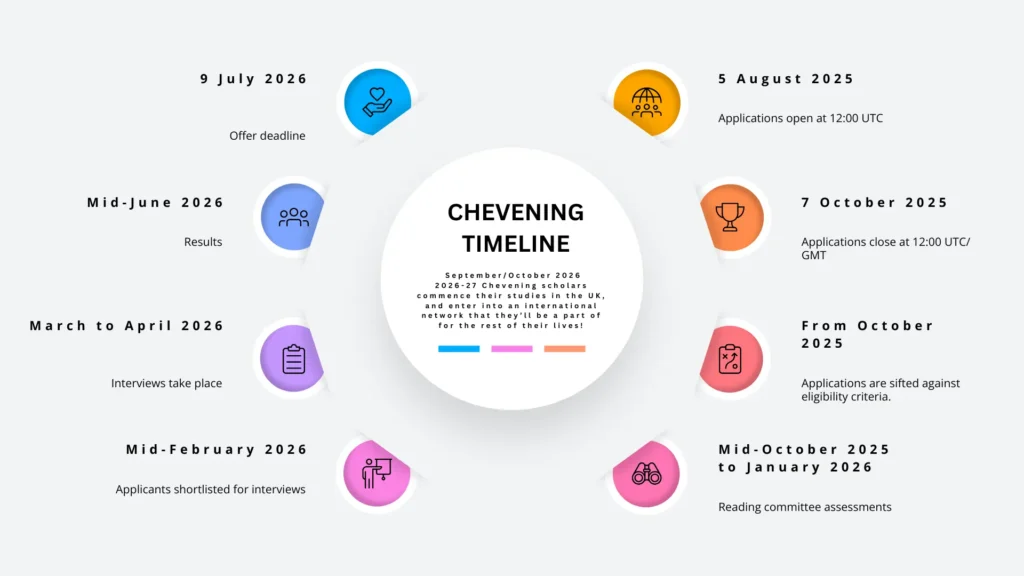
Visual timeline infographic showing the complete Chevening cycle from August to September the following year

The Critical Dates You Cannot Afford to Miss

Let’s get specific. These are the Chevening scholarship deadlines that will make or break your application.

Application Opening Date

When: Early August (typically the first Tuesday) What happens: The application portal goes live at 12:00 noon (UK time)

The Chevening scholarship application open date is when the starting gun fires. Now, do you need to submit on day one? Absolutely not. In fact, I’d argue against it. But knowing when applications open helps you plan your timeline backward.

Pro tip: Don’t wait until you can access the portal to start working on your application. The essay questions rarely change dramatically year to year. You can (and should) start drafting responses months in advance.

The November Crunch: Application Deadline

When: Early November (usually the first Tuesday or Wednesday) What happens: Portal closes at 12:00 noon (UK time) Why November matters: This is THE big one

The Chevening deadline November isn’t just important—it’s everything. This is your Chevening scholarship application closing date, and when that clock strikes noon in London, it’s over. The portal locks. Your half-finished application sits forever incomplete in digital purgatory.

I cannot stress this enough: UK time means UK time. Whether you’re in Pakistan (5 hours ahead), California (8 hours behind), or anywhere else on this spinning rock, you need to convert to Greenwich Mean Time or British Summer Time (depending on the season).

Chevening scholarship deadline UK operates independently of your local clock. Set multiple alarms. Use timezone converters. Ask a friend in London to give you a wake-up call if necessary.

Your LocationTime Difference from UKLocal Deadline Time (if UK deadline is 12:00 PM)
Pakistan (PKT)+5 hours5:00 PM same day
India (IST)+5:30 hours5:30 PM same day
Nigeria (WAT)+1 hour1:00 PM same day
USA East Coast (EST)-5 hours7:00 AM same day
USA West Coast (PST)-8 hours4:00 AM same day
Australia Sydney (AEDT)+11 hours11:00 PM same day
Kenya (EAT)+3 hours3:00 PM same day

Interview Period: The Waiting Game Ends

When: January through March (typically) What happens: Country-specific interview panels convene Duration: Usually 20-30 minutes per candidate

So you’ve submitted. You’ve obsessively checked your email. You’ve had stress dreams about missed deadlines. Now comes the Chevening scholarship interview dates notification.

The Chevening scholarship interview deadlines vary by country, which makes sense when you think about it—they’re not going to interview 55,000 applicants globally in a single week. Your local British Embassy or High Commission coordinates interviews in your region.

Chevening interview schedule notifications usually arrive via email in late December or January. When you get that email (notice I said “when,” not “if”—positive thinking), you’ll typically have a few weeks’ notice before your actual interview date.

Here’s what most people don’t realize: there’s often a Chevening scholarship interview deadline to confirm your attendance. Miss that confirmation deadline, and you might forfeit your slot. Read emails carefully. Set reminders. Respond promptly.

Results and Conditional Offers

When: Late May through June What happens: The “yes,” “no,” or “reserve list” email arrives

The Chevening scholarship results date is when months of waiting finally end. If you receive a conditional offer, congratulations! But don’t pop the champagne just yet—your work isn’t finished.

A conditional offer means you’re in, pending you meeting certain requirements. These typically include:

  • Securing admission to a UK university
  • Meeting English language requirements
  • Obtaining an unconditional offer from your chosen institution

The Unconditional Offer Deadline: Often Overlooked, Always Critical

When: Mid-July (specific date provided in your conditional offer) What happens: You must upload unconditional university offers

The Chevening unconditional offer deadline trips up more people than you’d think. You’ve done all this work to win the scholarship, and then you forget to submit the final paperwork proving you’ve been accepted to a UK university.

This deadline is non-negotiable. No unconditional offer uploaded by the deadline? Your Chevening scholarship evaporates. Poof. Gone.

Country-Specific Variations: Why Location Matters

Here’s where things get slightly complicated. While the main Chevening application deadline is universal, some aspects vary by country.

Chevening Deadline Countries: Regional Differences

Chevening deadline countries operate under a somewhat centralized system, but local British embassies and high commissions have some flexibility in managing their specific processes.

For example:

  • Chevening scholarship deadline Pakistan follows the global timeline, but interview dates are coordinated through the British High Commission in Islamabad
  • Some countries with smaller applicant pools might complete interviews faster
  • Certain regions might have additional documentation requirements

The key is checking your specific country page on the official Chevening website. Don’t assume that what applies to applicants in Nigeria necessarily applies to you in Indonesia.

The Clock Is Ticking: Time-Specific Considerations

Let’s talk about something that sounds trivial but absolutely isn’t: the exact time applications close.

Chevening Scholarship Deadline Time: Down to the Minute

The Chevening scholarship deadline time is 12:00 noon UK time. Not 11:59 AM. Not 12:01 PM. Noon. On the dot.

But here’s the sneaky bit: should you wait until 11:55 AM to hit submit? Absolutely not. Here’s why:

Server load: Thousands of procrastinators (no judgment, we’ve all been there) hammer the servers in the final hours. Things slow down. Sometimes things crash.

Technical glitches: Your internet might hiccup. Your computer might decide it’s the perfect time to install updates. Murphy’s Law is real.

Confirmation processing: Even after you hit submit, the system needs time to process and confirm your submission. Build in a buffer.

Chevening scholarship deadline time zones become crucial in the final hours. If you’re used to thinking in your local time, the stress of deadline day can make conversion errors more likely.

My recommendation? Aim to submit at least 24 hours before the deadline. Better yet, 48 hours. Give yourself breathing room for disaster recovery if something goes wrong.

Building Your Personal Deadline Calendar

Generic advice is fine, but let’s make this actionable. Here’s how to create a Chevening scholarship deadline calendar that actually works for you.

August: Application Opens

Your Action Items:

  • Create a Chevening application portal account on day one
  • Download and review the application form and essay questions
  • Begin drafting your first essay (yes, already)
  • Reach out to potential referees

Time investment: 5-10 hours this month

September: Deep Work Month

Your Action Items:

  • Write and rewrite all four essays
  • Research UK universities and specific courses
  • Begin gathering required documents (transcripts, employment letters, etc.)
  • Have someone review your essays for coherence and grammar

Time investment: 20-30 hours this month

October: The Final Push

Your Action Items:

  • Finalize all essays (they should be 95% done by October 1)
  • Double-check all referees have received and understood their instructions
  • Upload all required documents
  • Review entire application for consistency and completeness
  • Submit by mid-October (yes, really—three weeks before deadline)

Time investment: 15-25 hours this month

Insert table: Month-by-Month Deadline Preparation Strategy

MonthPriority TasksHours NeededDeadline Risk Level
AugustAccount setup, initial planning5-10Very Low
SeptemberEssay writing, university research20-30Low
OctoberFinal revisions, document uploads15-25Medium
November (pre-deadline)Last checks, submission5-10HIGH
January-MarchInterview preparation10-20Medium
April-JuneUniversity applicationsVariableMedium
JulyUnconditional offer submission5-10HIGH

Common Deadline Disasters (And How to Avoid Them)

Let’s learn from other people’s mistakes so you don’t have to make them yourself.

Disaster #1: The Timezone Catastrophe

Remember Amara from the introduction? Don’t be Amara.

Solution: Set all your deadline reminders in UK time. Use a timezone converter like timeanddate.com and double-check your math. When in doubt, submit early.

Disaster #2: The Referee No-Show

You submit your application on time, feeling accomplished. Then you realize only one of your three required referees has actually submitted their reference. The Chevening application deadline passes. Your application is incomplete.

Solution: Contact referees at least six weeks before the deadline. Follow up weekly (politely). Have backup referees ready. Some applicants even write draft references to make their referees’ lives easier (though be careful with this approach—it needs to feel authentic).

Disaster #3: The Document Format Fiasco

You upload your documents at 11:30 AM on deadline day. The system rejects them because they’re in the wrong format or exceed file size limits. You scramble to convert files. Time runs out.

Solution: Upload documents weeks in advance. Test file formats. Keep backups in multiple formats (PDF is usually safest). Read the technical requirements carefully.

Disaster #4: The University Offer Limbo

You win a conditional Chevening offer. Congratulations! But then university application deadlines come and go while you’re still deciding where to apply. The Chevening unconditional offer deadline arrives, and you have nothing to submit.

Solution: Start researching universities in September, even before you know if you’ll win Chevening. Submit university applications in January/February. Don’t wait for Chevening results before applying to universities.

Can You Get an Extension? (Spoiler: Probably Not)

Let’s address the elephant in the room: Chevening scholarship extension deadline requests.

Can you request an extension on Chevening deadlines? Technically, you can request anything. Will they grant it? Almost certainly not.

The Chevening website explicitly states that Chevening scholarship deadline time is final and that no extensions are granted under any circumstances. They mean it. Family emergencies, technical difficulties, natural disasters—the policy remains unchanged.

The only slight exception relates to the Chevening unconditional offer deadline, where extraordinary circumstances might be considered if you’ve already been awarded the scholarship. But even then, don’t count on it.

Chevening scholarship application date extensions simply don’t exist for the initial application. This isn’t about being harsh—it’s about fairness. If they made exceptions for some applicants, it would create an uneven playing field.

Interview Timeline: What Happens After You Submit

You’ve made the Chevening scholarship application close deadline. Now what?

December: The Silence

Nothing happens. Your inbox remains stubbornly empty. This is normal. The selection panels are reviewing thousands of applications. Resist the urge to email them asking about your status.

January: Interview Invitations Begin

Chevening scholarship interview notification date typically falls in January. Notifications roll out over several weeks, so if your friend got their invitation and you haven’t, don’t panic yet.

The invitation email includes:

  • Your interview date and time
  • Location (usually your local British Embassy/High Commission)
  • Chevening interview invitation deadline to confirm attendance
  • Format details (in-person, virtual, panel size)

February-March: Interview Season

Most Chevening scholarship interview deadlines cluster in this period. Your specific Chevening interview schedule depends on your country and how many applicants are being processed.

Interviews typically last 20-30 minutes and follow a structured format. The panel—usually three people—will have read your application and prepared questions tailored to your essays and career plans.

Beyond the Application: Other Critical Deadlines

Winning the scholarship is just the beginning. Here are the Chevening scholarship accepted deadlines you’ll face after receiving a conditional offer:

University Application Deadlines

Most UK universities have rolling admissions, but popular programs fill up. Don’t wait until July to start applying. Aim for February/March submissions.

English Language Certification

If you need to take IELTS or another English test, don’t leave this until the last minute. Test dates fill up, and you might need to retake if your scores aren’t high enough.

Visa Application Timeline

The Chevening scholarship visa application deadline is technically when you need to enter the UK by, but visa processing can take 3-8 weeks. Start the process as soon as you receive your unconditional university offer and Chevening confirmation.

Real Talk: Managing Deadline Stress

Let’s be honest—this entire process is stressful. You’re juggling regular life (work, family, other responsibilities) while completing one of the most competitive scholarship applications in the world.

Here’s how to stay sane:

Break it down: Don’t think about “completing the entire Chevening application.” Think about “finishing essay one” or “contacting referee number two.” Small wins compound.

Build buffer time: Whatever deadline you’re working toward, set your personal deadline two weeks earlier. This gives you disaster recovery time.

Use technology wisely: Set multiple reminders for every deadline. Use Google Calendar with alerts. Set phone alarms. Write physical notes. Redundancy is your friend.

Don’t go it alone: Join online communities of Chevening applicants. Share stress, strategies, and support. Knowing others are in the same boat helps enormously.

Remember why you’re doing this: On tough days, reconnect with your motivation. What will winning this scholarship make possible? Who will it allow you to become? Keep that vision clear.

The Final Countdown: Last Week Before Deadline

It’s the last week before the Chevening scholarship final deadline. Here’s your hour-by-hour survival guide:

7 Days Before:

  • Complete final review of entire application
  • Verify all referees have submitted (check with them directly)
  • Confirm all documents are uploaded correctly
  • Print a backup copy of everything

5 Days Before:

  • Do one more proofread (fresh eyes catch things)
  • Have someone else read through your essays
  • Check that you’ve answered every single question
  • Verify your contact information is correct

3 Days Before:

  • Don’t make major changes—you’re in polish mode only
  • Fix any minor typos or formatting issues
  • Take a complete screenshot/PDF of your finished application
  • Breathe

24 Hours Before:

  • If you haven’t submitted yet, now is the time
  • Resist the urge to keep tinkering
  • Submit and walk away from the computer
  • Do something completely unrelated to Chevening

Quick Reference: Key Dates at a Glance

Here’s everything condensed into one easy reference:

Insert table: Complete 2025 Chevening Deadline Overview

MilestoneApproximate TimingAction RequiredFlexibility
Application OpensEarly AugustCreate account, start draftingHigh
Application ClosesEarly November, 12:00 PM UK timeSubmit complete applicationZERO
Interview InvitationsDecember-JanuaryRespond to confirm attendanceLow
InterviewsJanuary-MarchAttend interviewLow
Results AnnouncedLate May-JuneAccept conditional offerLow
University ApplicationsJanuary-AprilApply and receive offersMedium
Unconditional Offer SubmissionMid-JulyUpload proof of university admissionZERO
Visa ApplicationJuly-AugustSubmit visa applicationLow
Pre-departure BriefingAugust-SeptemberAttend orientationLow
Arrival in UKSeptember-OctoberBegin studiesLow

Your Action Plan Starts Now

Look, I get it. You’re reading this article, and maybe the deadline feels far away. Or maybe it’s breathing down your neck. Either way, here’s what you do right this second:

Action Step 1: Open your calendar app right now. Today. Not after you finish reading this.

Action Step 2: Mark the Chevening application deadline 2025 in UK time. Set three separate reminders: one month before, one week before, and 48 hours before.

Action Step 3: Working backward from that deadline, schedule specific tasks. “Write essay 1” on September 15. “Contact referee 2” on September 1. “Upload transcripts” on October 10.

Action Step 4: Set your personal submission deadline for at least two weeks before the official one. Mark it as a hard deadline in your mind.

Action Step 5: Join online Chevening applicant communities. Facebook groups, Reddit threads, whatever platform works for you. You’ll find timeline advice, deadline reminders, and moral support.

The Truth About Deadlines

Here’s something I wish someone had told me earlier: Chevening scholarship deadlines aren’t just bureaucratic hurdles—they’re actually helpful.

Weird take, I know. But think about it: without firm deadlines, you could endlessly tinker with your essays, perpetually research universities, and never actually submit anything. The deadline forces completion. It says, “This is good enough. Let it go into the world.”

Your application doesn’t need to be perfect. It needs to be complete, honest, compelling, and submitted on time. That’s it.

Some of the most successful Chevening scholars I know submitted applications they considered “pretty good” rather than “flawless.” They respected the deadlines, did their honest best, and let the chips fall where they may.

When Things Don’t Go According to Plan

What if you genuinely cannot make the deadline? Technical catastrophe, family emergency, act of God?

First, try everything humanly possible to submit on time. Get to an internet café. Borrow a friend’s computer. Pull an all-nighter. The Chevening scholarship application deadline is inflexible, so exhaust every option.

If you truly cannot submit, accept that this year isn’t your year. It’s disappointing, absolutely. But Chevening accepts applications annually. Learn from this year’s process, start earlier next time, and come back stronger.

Missing the deadline isn’t the end of your dreams—it’s a detour. Plenty of scholars won on their second or third application attempt. Persistence counts for something.

Final Thoughts: You’ve Got This

If you’ve read this far, you’re clearly serious about this opportunity. That dedication will serve you well throughout the application process and beyond.

The Chevening scholarship deadlines might seem daunting, but they’re entirely manageable with proper planning. Break the process into small pieces. Start early. Build in buffers. Ask for help when you need it.

Thousands of people just like you successfully navigate these deadlines every year. You can absolutely be one of them.

Now stop reading articles about deadlines and start working toward them. Your future self—the one studying in the UK, building a global network, and working toward the change you want to see in the world—is counting on you to submit that application on time.

Set those reminders. Make that plan. Do the work.

And I’ll see you in the UK.

Important Note: While this guide provides comprehensive deadline information, always verify specific dates on the official Chevening website. Deadlines occasionally shift slightly from year to year, and country-specific variations may apply. When in doubt, the official Chevening portal is your authoritative source.

Filed Under: GUIDES

Chevening Eligibility 2025: Your Complete Guide to Qualifying for the UK’s Premier Scholarship

October 8, 2025 by Amina Shah

There’s a special kind of heartbreak reserved for spending forty hours perfecting a scholarship application only to discover—right before hitting submit—that you never qualified in the first place.

I’ve seen it happen. Brilliant candidates who poured everything into their essays, secured glowing references, researched universities meticulously, only to realize at the eleventh hour that they needed 2,800 work hours and they only had 2,600. Or that their dual British citizenship made them ineligible. Or that their country wasn’t on the list.

Chevening eligibility 2025 isn’t the sexy part of the application. Nobody brags about meeting minimum requirements. But it’s the foundation. Get this wrong and nothing else matters.

So let’s make absolutely sure you qualify before you invest a single hour into this process.

The Five Core Chevening Eligibility Requirements

The Chevening scholarship eligibility criteria boils down to five non-negotiable requirements. All five. Not four out of five. Not “close enough.” All five.

1. Citizenship: Are You From an Eligible Country?

The rule: You must be a citizen of a Chevening-eligible country or territory.

What this means:

  • You hold a passport from an eligible country
  • You can prove your citizenship
  • Your country has diplomatic relations with the UK
  • Your country is on the official Chevening list

The Chevening country eligibility 2025 list includes 160+ countries and territories. Most nations worldwide qualify, but there are notable exceptions based on current diplomatic relations.

Who qualifies:

  • Citizens of eligible countries (check official Chevening website)
  • People who hold citizenship exclusively from eligible countries
  • Those who can obtain passports from eligible countries

Who does NOT qualify:

  • British citizens (sorry, this is for international development)
  • Dual British citizens (even if other citizenship is eligible)
  • Permanent residents of eligible countries without citizenship
  • Refugees or stateless persons (some exceptions—see special section below)

The gray areas:

Dual citizenship (non-British): If you hold citizenship from two eligible countries, you’re fine. You just need to specify which country you’re representing and return there after your scholarship.

Recently changed citizenship: If you recently became a citizen of an eligible country (through naturalization, marriage, etc.), you must hold the passport before applying.

Pending citizenship: “I’m about to get citizenship” doesn’t count. You need to actually have it when you apply.

Country-Specific Notes

Chevening eligibility Pakistan 2025: Pakistani citizens are eligible and Pakistan receives a healthy allocation of scholarships. However, competition is fierce with thousands of qualified applicants.

Chevening eligibility India 2025: Indian citizens are eligible. India typically has one of the largest applicant pools, so strong applications are essential.

Chevening eligibility Nigeria 2025: Nigerian citizens are eligible with significant scholarship allocation due to historical UK-Nigeria ties.

2. Academic Qualification: Do You Have the Right Degree?

The requirement: An undergraduate degree that qualifies you for entry to a postgraduate program at a UK university.

In practical terms:

What qualifies:

  • Bachelor’s degree (4 years typical)
  • Bachelor’s honours degree (3 years in UK system)
  • Equivalent qualifications recognized by UK universities
  • Professional qualifications deemed equivalent to bachelor’s degree

Minimum grade: Generally, you need at least upper second-class honours (2:1) or equivalent. Some define this as:

  • 60% or above
  • 3.0+ GPA on a 4.0 scale
  • First division
  • “Good” or “Merit” classification

What complicates things:

Chevening undergraduate degree eligibility varies by education system. If your degree isn’t from UK, US, Canada, Australia, or similar systems, UK universities may require credential evaluation.

The grade equivalency challenge: What counts as “2:1 equivalent” differs by country. A 70% in Pakistan might equal a 2:1, while in the UK itself you’d need 60-69%.

Three-year vs. four-year degrees: Most UK universities accept both, but some competitive programs prefer four-year degrees or additional qualifications.

Professional qualifications: Engineering council certifications, medical degrees, law degrees—these typically qualify, but verify with specific universities.

What if you have a master’s already?

Chevening eligibility with master’s degree: You CAN apply if you already have a master’s degree, BUT:

  • Your previous master’s must not have been funded by the UK government
  • You must justify why you need another master’s
  • You can’t pursue the same field unless there’s clear differentiation
  • Your application needs stronger justification

The tricky situation: “I’m completing my bachelor’s now—can I apply?”

Yes, IF:

  • You’ll have completed your degree before Chevening deadline
  • You can provide transcripts and provisional certificates
  • Your final grades meet requirements
  • You can secure university offers based on pending completion

3. Work Experience: The 2,800-Hour Rule

This is where most confusion happens. Let’s demystify Chevening work experience eligibility 2025.

The specific requirement: 2,800 hours of work experience, which equates to approximately two years of full-time work.

What counts:

Paid employment:

  • Full-time jobs
  • Part-time jobs (hours add up cumulatively)
  • Internships (paid or unpaid)
  • Freelance or consulting work
  • Contract work

Volunteer work:

  • Structured volunteer positions with organizations
  • Community service with documented hours
  • NGO or charity work
  • Board memberships with active roles

Self-employment:

  • Business ownership
  • Freelancing
  • Consulting
  • Entrepreneurship

The calculation:

Full-time work:

  • 40 hours/week × 52 weeks × 2 years = 4,160 hours (exceeds requirement)
  • If you worked 2 years full-time, you definitely qualify

Part-time work:

  • 20 hours/week × 52 weeks × 3 years = 3,120 hours (qualifies)
  • Must track actual hours worked

Mixed experience:

  • 1 year full-time (2,080 hours) + 1 year part-time 15 hours/week (780 hours) = 2,860 hours (qualifies)

What does NOT count:

During full-time studies: Part-time work during undergraduate or master’s studies generally doesn’t count unless:

  • It was substantial (20+ hours/week consistently)
  • It can be documented
  • It wasn’t just summer work

Unpaid family business help: Unless you had a formal role with documented hours, helping in the family shop doesn’t count.

Academic projects or coursework: University assignments, thesis work, research as part of your degree—these are education, not work experience.

Very casual work: Occasional babysitting, tutoring a few hours a month, sporadic freelance projects—these are hard to document and likely don’t add up to much.

The documentation requirement:

You must be able to prove your work experience with:

  • Employment letters
  • Contracts
  • Pay stubs
  • Letters from organizations (for volunteer work)
  • References from supervisors

Can you apply without work experience?

Chevening eligibility without work experience: No. The 2,800-hour requirement is non-negotiable. If you’re short, you need to:

  • Wait and gain more experience
  • Count all eligible experience you might have overlooked
  • Apply next year when you qualify

The gray area—recent graduates:

If you graduated last year and have been working since, you might be close. Calculate carefully. Include:

  • Any substantial part-time work during final university year
  • Summer internships
  • Post-graduation employment
  • Volunteer work

4. University Offers: The Three-Course Requirement

The requirement: You must apply to three different UK universities for three different eligible master’s courses, and receive at least one unconditional offer by the deadline.

Breaking this down:

Three different universities: Not three courses at Oxford. Not University of London (which has multiple colleges—pick different ones). Three entirely separate institutions.

Three different courses: They can be in the same field but must be different programs with different titles at different universities.

Eligible courses:

  • Must be on Chevening’s eligible course list
  • Usually one-year master’s programs
  • Starting in autumn 2025
  • At recognized UK universities

At least one unconditional offer: By the deadline specified in your award (typically July-August), you must have at least one unconditional offer. Conditional offers are fine initially, but you must convert at least one.

Why this is critical: You can win the Chevening scholarship but lose it if you don’t secure university admission. The scholarship funds your education—if you can’t get admitted, there’s nothing to fund.

5. Return Home Requirement: The Two-Year Commitment

The rule: You must return to your country of citizenship for a minimum of two years after your scholarship ends.

Chevening return home requirement 2025 is contractual. This isn’t a suggestion—it’s a legal obligation.

What this means:

You must:

  • Return within a month of course completion
  • Stay in your home country for at least 24 months
  • Work or pursue activities in your home country
  • Maintain your primary residence there

You cannot:

  • Stay in the UK after completing your course (beyond short visa extensions)
  • Relocate to a third country immediately after
  • “Visit” your home country briefly then leave again

Exceptions: Very limited. Medical emergencies, serious family situations—but you’d need approval and documentation.

Why it matters: Chevening invests in you expecting you’ll return home and create impact. Violating this can require full scholarship repayment and bar you from future UK government opportunities.

The mindset: Don’t apply for Chevening if your goal is UK immigration. There are other pathways for that. Chevening is about returning home as a stronger leader.

Special Circumstances and Edge Cases

Chevening Eligibility for Refugees 2025

Stateless persons and refugees face unique challenges:

Generally: You must hold citizenship from an eligible country. However:

  • Some countries have special provisions
  • British Council in your location may offer guidance
  • You’ll need to demonstrate strong ties to a country you’ll return to

Contact the Chevening team directly if you’re in this situation. They handle case-by-case.

UK Citizens and Permanent Residents

Chevening scholarship eligibility UK citizens: Not eligible. This includes:

  • British citizens by birth
  • Naturalized British citizens
  • British Overseas Territories citizens
  • Dual citizens where one citizenship is British

UK permanent residents: Not eligible either, unless you also hold citizenship from an eligible country and you’ll be representing that country.

Age Limits

Chevening scholarship age eligibility 2025: There is NO upper age limit. Whether you’re 23 or 43 or 63, if you meet all other criteria, you can apply.

Minimum age: You must be at least 18 years old when you apply (which means born before the application deadline).

English Language Requirements

Chevening English language eligibility 2025: Chevening itself doesn’t set English requirements, but UK universities do.

What you’ll typically need:

  • IELTS: Overall 6.5-7.0 (varies by university)
  • TOEFL: 90-100+ (varies by university)
  • Other tests: PTE, Cambridge English, etc.

Exemptions: If your undergraduate degree was taught entirely in English at a recognized institution, many universities waive the test requirement.

Strategy: Take the test early. Don’t wait until you win Chevening—you need scores for university applications.

Eligibility Updates and Changes for 2025

Chevening eligibility criteria update 2025:

While core requirements remain stable, always check the official website for:

  • Changes to eligible countries list (diplomatic relations shift)
  • Updated work experience documentation requirements
  • New eligible courses or universities
  • Any policy adjustments

Recent clarifications:

  • Work experience calculation methods
  • What qualifies as “equivalent” degrees
  • Documentation requirements for various circumstances

Your Eligibility Verification Checklist

Chevening eligibility requirements checklist:

□ Citizenship

  • I hold citizenship from an eligible Chevening country
  • I am NOT a British citizen or dual British citizen
  • I can provide passport as proof

□ Education

  • I have a bachelor’s degree or equivalent
  • My degree qualifies me for UK postgraduate admission
  • My grades meet minimum requirements (2:1 or equivalent)
  • I have official transcripts available

□ Work Experience

  • I have at least 2,800 hours of qualifying work experience
  • I can document all of this experience
  • My experience meets Chevening definitions
  • I have employment letters or references available

□ University Applications

  • I can identify three eligible UK universities
  • I can apply to three different courses
  • I meet entry requirements for these courses
  • I can secure at least one unconditional offer by deadline

□ Return Commitment

  • I am willing and able to return home for two years
  • I understand this is legally binding
  • My career plans involve returning home
  • I’m not using Chevening for immigration purposes

□ Additional Requirements

  • I have not previously studied in UK with UK government funding
  • I am not an employee of HMG or British diplomatic missions
  • I am not a relative of HMG employees
  • I meet English language requirements for my chosen universities

What If You’re Almost Eligible?

Scenario 1: “I have 2,600 hours of work experience”

Options:

  • Wait and apply next year when you’ll have enough hours
  • Carefully review ALL your experiences—you might have overlooked volunteer work or part-time roles that add up
  • Don’t fudge numbers—they verify this

Scenario 2: “I’ll graduate in 3 months”

You can apply IF:

  • You’ll complete degree before the application deadline
  • You can get provisional documentation
  • Your university will confirm your expected classification
  • You can demonstrate to UK universities you’ll meet requirements

Scenario 3: “My country isn’t on the list”

Unfortunately: Wait and hope diplomatic relations change, or explore other scholarship opportunities. Chevening eligibility is tied to diplomatic relationships.

Scenario 4: “I’m a dual British-Pakistani citizen”

Sadly: Not eligible. Even if your second citizenship is from an eligible country, holding British citizenship disqualifies you.

Common Eligibility Mistakes

Why applications get rejected on eligibility:

1. Citizenship confusion: Assuming permanent residency equals citizenship. It doesn’t.

2. Work experience miscalculation: Counting hours that don’t qualify, or overestimating part-time work.

3. Incomplete documentation: Unable to prove work experience claims when asked.

4. Academic requirement misunderstanding: Thinking a diploma or certificate equals a bachelor’s degree.

5. UK immigration intentions: Application makes it clear they plan to stay in UK after, not return home.

Take the Eligibility Test

Many people find it helpful to use a Chevening eligibility quiz to verify they qualify. While this article covers everything, quick yes/no questions can help:

Quick Self-Assessment:

  1. Are you a citizen (not just resident) of a Chevening-eligible country? YES/NO
  2. Do you hold British citizenship or dual British citizenship? YES/NO (NO qualifies you)
  3. Do you have a bachelor’s degree or equivalent? YES/NO
  4. Do you have at least 2,800 hours of work experience? YES/NO
  5. Can you apply to three different UK universities? YES/NO
  6. Are you willing to return home for two years minimum? YES/NO
  7. Can you start a master’s in September/October 2025? YES/NO

If you answered YES to questions 1, 3-7 and NO to question 2: You’re eligible!

Any other combination: Review the specific requirement you don’t meet.

Final Thoughts: Eligibility as Your Foundation

Understanding Chevening eligibility 2025 isn’t glamorous. Nobody includes “verified my eligibility” in their success story. But it’s essential.

The truth: Chevening receives 60,000+ applications for 1,500 scholarships. They don’t have time to be flexible with eligibility requirements. You either qualify or you don’t.

The good news: If you qualify, you’re in the game. Your eligibility doesn’t determine whether you win—your leadership, your vision, your application quality does that. But eligibility gets you through the door.

So verify carefully:

  • Check your citizenship status
  • Calculate your work hours precisely
  • Confirm your degree equivalency
  • Plan your university applications
  • Understand the return commitment

Then, and only then, move forward with confidence.

Because there’s nothing worse than realizing—after forty hours of work—that you never qualified in the first place.

And there’s nothing better than clicking “submit” knowing you absolutely, definitely, unquestionably meet every single requirement.

You’ve got this. Now go verify your eligibility, and then let’s get that application written.

Ready to proceed? If you meet all eligibility requirements, check out our comprehensive application guide, essay writing tips, and interview preparation resources. Your Chevening journey starts with eligibility—but it doesn’t end there.

Filed Under: GUIDES

Chevening Success Stories: Real People, Real Impact, Real Inspiration

October 8, 2025 by Amina Shah

Let me tell you about Amina.

She grew up in a village in northern Nigeria where electricity was sporadic and the nearest university was three hours away by bumpy bus. Her secondary school had one computer for 400 students. When she told people she wanted to study renewable energy in the UK, they smiled politely—the kind of smile that says “that’s nice, dear” while thinking “never gonna happen.”

Today, Amina runs a solar energy company that’s brought electricity to over 50,000 homes across rural Nigeria. She employs 200 people. She advises the government on energy policy. And yes, she’s a Chevening alumna.

These Chevening success stories aren’t fairy tales. They’re blueprints. Real people, real challenges, real transformations. And if you’re reading this wondering whether you have what it takes, the answer in these stories might surprise you.

Why Success Stories Actually Matter

Before we dive into individual Chevening scholarship success stories, let’s talk about why these narratives are more than just feel-good content.

When you’re staring at that application form at 2 AM, doubting whether your leadership experience is “impressive enough” or your English is “good enough,” these stories do something practical: they show you the range of people who’ve actually won.

What you’ll notice in these stories:

  • Not everyone came from elite universities
  • Not everyone had perfect English
  • Not everyone worked for famous organizations
  • Not everyone had straightforward journeys

What they all had:

  • Clear vision for impact
  • Demonstrated initiative
  • Genuine commitment to their home countries
  • The courage to apply despite doubts

That last one matters more than you might think.

The Teacher Who Revolutionized Rural Education

Country: Pakistan
Field: Education Policy
University: University College London
Current Role: Director of Curriculum Development, National Education Ministry

Fatima’s Story

Fatima taught mathematics at a government girls’ school in rural Sindh. Not exactly the glamorous start to a Chevening scholar story you might expect, right?

But here’s what made her application compelling: she didn’t just teach. She identified that girls in her district were dropping out at alarming rates after primary school. Instead of accepting this as “just how things are,” she did something about it.

What she did:

  • Created a community mobilization program involving parents, religious leaders, and local officials
  • Developed culturally sensitive materials addressing common objections to girls’ education
  • Established a mentorship network connecting educated women with students
  • Tracked outcomes: dropout rates fell by 35% in three years

Her Chevening application focused on:

  • Specific leadership actions, not philosophy
  • Measurable impact with real numbers
  • Clear vision: scale these solutions nationally through policy work
  • Why UK: study comparative education systems to understand what works in similar contexts

The UK year: At UCL, Fatima studied international education policy. She didn’t just attend lectures—she connected UK approaches with Pakistan’s challenges, built relationships with education NGOs, and prepared for her return.

After Chevening: She returned to Pakistan and joined the education ministry. Five years later, she’s leading national curriculum reform. Her community-based approach to retention is now being piloted in 12 districts. That’s 500,000 girls with better educational opportunities.

The lesson: You don’t need a fancy job title to have impressive leadership experience. You need demonstrated impact.

The Engineer Who Rebuilt After Disaster

Country: Philippines
Field: Disaster Risk Management
University: University of Manchester
Current Role: Chief Resilience Officer, Metro Manila

Carlos’s Journey

Carlos was a civil engineer in Tacloban when Typhoon Haiyan hit in 2013. His office building collapsed. His family’s home was destroyed. He spent three weeks doing rescue work before he could even assess his own losses.

This is where most Chevening success stories Pakistan or Philippines focus on the triumph. But let’s talk about the messy middle, because that’s where the real story lives.

The challenge: Carlos had technical engineering skills but realized disaster response needed more than good infrastructure. It needed community preparedness, political will, and systematic change.

His leadership emergence:

  • Organized neighborhood disaster response teams
  • Created simple, visual early warning systems for non-literate communities
  • Convinced local government to allocate 5% of budget to resilience planning
  • Built coalition between engineers, social workers, and community leaders

The Chevening application: Carlos’s essays didn’t hide the trauma or difficulty. He wrote honestly about feeling overwhelmed, about failures and lessons learned. But he showed how those experiences crystallized his commitment to systematic disaster resilience.

His networking essay was particularly strong—he demonstrated how he’d already built bridges between technical experts and community members, and how he’d leverage the Chevening network to connect Southeast Asian disaster response practitioners.

During his UK year: He studied Urban Resilience and Disaster Risk Management. He also spent time connecting with scholars from earthquake-prone countries (Nepal, Turkey, Chile) sharing strategies and building lasting collaborations.

The transformation: Back in Manila, Carlos didn’t just apply his learning—he multiplied it. He trained 500+ local officials in resilience planning. He helped design building codes that consider both technical standards and economic realities. His disaster preparedness model is being adopted across ASEAN countries.

The unexpected outcome: Carlos was recently invited to contribute to UN Habitat’s global resilience framework. A kid from Tacloban influencing international policy.

The lesson: Your most challenging experiences can become your most compelling stories. Don’t hide difficulty—show how it shaped your commitment.

The Journalist Who Amplified Marginalized Voices

Country: Kenya
Field: Media and Communications
University: City, University of London
Current Role: Founder, Inclusive Media Initiative

Grace’s Path

Grace’s Chevening scholarship experience is a masterclass in turning barriers into opportunities.

She worked for a small independent newspaper covering human rights issues. Not international journalism, not major publications. Just solid, local reporting that mattered to communities no one else was covering.

The turning point: Grace noticed that stories about indigenous communities, people with disabilities, and LGBTQ+ individuals were either absent or told poorly—often by people who’d never actually engaged with these communities.

Her initiative:

  • Created a training program for journalists from marginalized communities
  • Established guidelines for ethical, accurate reporting on underrepresented groups
  • Built a network of 50+ trained community correspondents
  • Published stories that changed policy on land rights and healthcare access

The Chevening application strategy: Grace’s leadership essay focused on three distinct examples: organizing the training program, convincing her editor to allocate resources, and building trust with communities that had been misrepresented by media.

Her career plan was crystal clear: return to Kenya, scale the training model nationally, establish a social enterprise that ensures sustainability.

UK experience highlights: At City, University of London, she studied International Journalism. She also:

  • Connected with BBC journalists working on diversity
  • Collaborated with scholars from Ghana and South Africa on pan-African media projects
  • Wrote her dissertation on inclusive journalism practices
  • Built relationships that continue to provide story-sharing and support networks

Back in Kenya: Grace founded the Inclusive Media Initiative—a social enterprise training journalists and placing stories in mainstream outlets. She’s trained 200+ journalists. Stories from her network have influenced three major policy changes.

She also mentors younger journalists and regularly speaks at universities about ethical reporting.

The unexpected development: International news organizations now consult her on coverage of African communities. CNN and Reuters have both featured her fellows’ work.

The lesson: Your unique perspective is your strength. Don’t try to look like everyone else—show how your different angle creates value.

The Healthcare Worker Who Transformed Rural Medicine

Country: India
Field: Public Health
University: London School of Hygiene & Tropical Medicine
Current Role: State Director of Rural Health Programs

Rajesh’s Mission

Rajesh’s Chevening alumni success stories journey began in a primary health center in rural Maharashtra, where he was a medical officer facing impossible ratios—one doctor for 30,000 people.

The reality:

  • Patients traveled 50+ kilometers for basic care
  • Preventable diseases killed children regularly
  • Maternal mortality was heartbreakingly high
  • Traditional healthcare delivery wasn’t working

His innovation: Instead of accepting limitations, Rajesh asked: what if we brought healthcare to people instead of waiting for people to come to healthcare?

What he built:

  • Mobile health clinics using converted vans
  • Training program for village health workers
  • Telemedicine connections to specialist doctors
  • Community health education programs
  • Basic diagnostic capabilities in remote areas

Results over three years:

  • Maternal mortality dropped 40%
  • Childhood vaccination rates increased from 45% to 87%
  • Early disease detection improved dramatically
  • Healthcare costs for families decreased

The Chevening application: Rajesh’s essays were ruthlessly specific. He didn’t write about “improving healthcare”—he wrote about reducing maternal mortality by 40% through mobile clinics serving 15 villages with detailed examples of challenges overcome.

His career plan outlined exactly how a UK master’s in public health would help him scale these solutions statewide, then nationally.

London learning: He studied health system strengthening and health policy. But he also:

  • Researched how Scotland and Wales handle rural healthcare
  • Connected with scholars tackling similar issues in Africa and Latin America
  • Attended WHO consultations open to students
  • Built relationships with UK health system innovators

Current impact: Rajesh now directs rural health programs for his entire state—population 40 million. His mobile health model is being adopted across India. He advises national policy on rural healthcare delivery.

He’s also training the next generation of health innovators, and three of his mentees have won competitive scholarships themselves.

The lesson: Scale matters. Show how your local solutions could transform larger systems.

The Environmental Activist Who Influenced Policy

Country: Brazil
Field: Environmental Policy
University: University of Oxford
Current Role: Environmental Policy Advisor to Government

Isabella’s Trajectory

Isabella’s Chevening scholarship success stories path started with activism—not always the most obvious route to a government scholarship.

Her background: She worked with an environmental NGO in the Amazon, organizing communities against illegal deforestation. This meant confronting powerful interests, documenting violations, and mobilizing international attention.

The challenge: Activism alone wasn’t changing policy. She realized she needed to understand policy mechanisms, economic incentives, and how to work within government systems.

Leadership demonstration:

  • Organized 50+ community groups into effective coalition
  • Documented illegal activities that led to prosecutions
  • Created sustainable livelihood alternatives to reduce community dependence on extractive industries
  • Built bridges between activists, scientists, and policymakers

Chevening application approach: Isabella was strategic. She didn’t hide her activism but framed it professionally:

  • Leadership wasn’t about protests—it was about building coalitions and creating alternatives
  • Her career plan showed clear evolution from activism to policy influence
  • She demonstrated understanding that lasting change requires working within systems

Oxford year: She studied Environmental Change and Management. The UK experience gave her:

  • Theoretical frameworks to understand policy processes
  • Comparative perspectives on conservation strategies
  • Credibility that opened doors back home
  • Global network of environmental policy professionals

The transformation: Isabella returned and was eventually recruited by the government she’d once opposed. Some former colleagues questioned this. But here’s what she’s accomplished:

  • Helped design payment-for-ecosystem-services programs protecting 2 million hectares
  • Incorporated indigenous community voices into national policy
  • Created economic incentives for conservation
  • Trained government officials in community engagement

The nuance: She hasn’t stopped activism—she’s made it more effective by working from inside the system while maintaining outside relationships.

The lesson: Career pivots are okay. Show how your experiences prepare you for your next chapter, even if it seems different from your current work.

Common Threads in Chevening Success Stories

Looking across these Chevening scholar stories, patterns emerge. Not formulas—every journey is unique—but common elements worth noting.

What Successful Scholars Share

QualityWhat It Looks LikeWhat It Doesn’t Look Like
Specificity“Reduced dropout rates by 35% across 12 schools”“Improved education in my community”
Initiative“Created a program when nothing existed”“Participated in my organization’s project”
Impact Focus“Changed policy affecting 50,000 people”“Gained valuable experience”
Clear Vision“Will establish social enterprise employing 100 people by 2028”“Want to help my country”
Authenticity“Failed twice before this approach worked”Everything sounds perfect
Strategic Thinking“UK expertise in X directly addresses Y challenge at home”“UK has good education”

The Journey Framework

Most Chevening success stories after scholarship follow a recognizable pattern:

Phase 1: Local Impact (Pre-Chevening)

  • Identify problem
  • Take initiative
  • Create measurable change
  • Hit ceiling requiring new skills/knowledge

Phase 2: Strategic Learning (During Chevening)

  • Acquire theoretical frameworks
  • Gain comparative perspectives
  • Build international network
  • Prepare for scaled impact

Phase 3: Multiplied Impact (Post-Chevening)

  • Apply learning at larger scale
  • Leverage network for collaborations
  • Train/mentor others
  • Influence policy or practice

Phase 4: Legacy Creation (5-10 years later)

  • Senior leadership positions
  • System-level change
  • Training next generation
  • International influence

Lessons From Application Success

These Chevening application success stories offer practical guidance for your own application.

What Made Their Applications Stand Out

1. Concrete Examples Over Abstract Claims

Weak: “I am a passionate leader committed to education” Strong: “I mobilized 30 community leaders to establish mentorship programs, reducing girl dropout rates by 35%”

2. Honest About Challenges

The best applications don’t present perfect journeys. They show:

  • Obstacles faced
  • Failures and what was learned
  • How difficulty strengthened commitment
  • Realistic acknowledgment of complexity

3. Clear Career Logic

Every strong application answers:

  • Why do you need THIS education?
  • Why specifically the UK?
  • Why THESE courses?
  • How does this connect past to future?
  • Why should they invest in YOU?

4. Genuine Commitment to Return

Successful scholars don’t treat the return requirement as a burden. Their applications show:

  • Deep connection to home country’s challenges
  • Specific plans for impact upon return
  • Understanding that their leadership is needed at home
  • Excitement about opportunities to create change

The Interview Success Factor

Chevening scholarship interview success stories highlight similar patterns:

What worked:

  • Being themselves, not performing
  • Speaking specifically about their work
  • Showing genuine enthusiasm
  • Handling tough questions honestly
  • Demonstrating preparation and research
  • Asking thoughtful questions

What didn’t:

  • Memorized, robotic answers
  • Vague or generic responses
  • Arrogance or false modesty
  • No knowledge of current affairs
  • Appearing disengaged or nervous to point of incoherence

The Perseverance Factor

Let’s talk about something most Chevening scholarship perseverance stories don’t emphasize enough: many successful scholars didn’t win on their first try.

Second (or Third) Time Success

Maria from Colombia: Rejected first time. Used feedback to strengthen essays, gained more work experience, reapplied and won.

Ahmed from Egypt: Rejected twice. Third application succeeded because he’d accumulated more concrete leadership examples and clarified his career plan.

Thandiwe from Zimbabwe: First rejection devastated her. Took a year, worked on a major project that strengthened her application significantly, won on second attempt.

The pattern:

  • Take rejection as feedback, not final judgment
  • Strengthen weak areas identified
  • Gain more experience and impact
  • Refine career clarity
  • Try again

The mindset: Each rejection makes you a stronger candidate if you use it strategically.

Success Beyond the Obvious Metrics

Chevening scholarship career success isn’t just about prestigious positions or high salaries. The real Chevening scholarship impact shows up in unexpected ways.

The Multiplier Effect

Network multiplication: Scholars don’t just advance their own careers—they create opportunities for others. They:

  • Mentor younger professionals
  • Create employment through enterprises
  • Open doors for colleagues
  • Share knowledge and resources
  • Build bridges between countries

Knowledge multiplication: The education isn’t hoarded—it’s shared:

  • Training programs passing skills to hundreds
  • Policy changes affecting thousands or millions
  • Models replicated in other contexts
  • Publications spreading best practices

Leadership multiplication: The best Chevening alumni success stories include scholars who:

  • Train the next generation of leaders
  • Create platforms for others to lead
  • Support younger scholars’ applications
  • Build institutions that outlast them

What These Stories Mean for You

If you’re reading these Chevening inspirational stories wondering whether you have what it takes, here’s what I want you to understand:

You don’t need to:

  • Come from a prestigious university
  • Work for a famous organization
  • Have perfect English
  • Know important people
  • Have a flawless background

You do need to:

  • Have demonstrated leadership with real impact
  • Possess clear vision for your future
  • Show genuine commitment to your home country
  • Be able to articulate your story compellingly
  • Have the courage to apply

The honest truth: Every person in these stories felt inadequate at some point. They doubted whether they were “Chevening material.” They worried their experience wasn’t impressive enough. They almost didn’t apply.

They applied anyway. And that made all the difference.

Your Success Story Starts Now

These Chevening success stories aren’t just inspiration—they’re evidence. Evidence that real people with real challenges and real commitment can win this scholarship and create extraordinary impact.

Your story might not look like Amina’s or Carlos’s or Grace’s. It shouldn’t. Your story should look like yours—authentic, specific, compelling.

But it might share their arc:

  • Identifying problems that matter
  • Taking initiative despite limitations
  • Creating measurable impact
  • Seeking knowledge to scale solutions
  • Returning home to multiply that impact
  • Eventually training and inspiring others

The question isn’t whether you’re good enough.

The question is: are you willing to do the work?

  • Research thoroughly
  • Write honestly
  • Apply strategically
  • Prepare intensively
  • Handle rejection as redirection if necessary
  • Keep pursuing your goals regardless of outcome

Because here’s the secret these Chevening scholar profiles reveal: the application process itself transforms you. Articulating your leadership makes you more conscious of it. Clarifying your career plan gives you direction. Researching your sector deepens your expertise.

Win or lose, you become a better version of yourself.

But you know what? You might just win.

And ten years from now, someone might be reading about YOUR success story, wondering if they have what it takes, finding courage in your journey.

So start your application. Write your story. Take your shot.

The world needs your leadership. Your community needs your vision. Your country needs your commitment.

And somewhere in the UK, lecture halls are waiting. Networks are forming. Opportunities are crystallizing.

Your seat at that table? It’s available. You just have to claim it.

Ready to write your own success story? Start by researching the Chevening application process, connecting with alumni in your country, and documenting your leadership experiences. Your journey begins with one decision: to try.

Share this article with someone who needs to see these stories. Future Chevening scholars are everywhere—sometimes they just need proof that people like them can succeed.

Filed Under: GUIDES

Mastering Your Chevening UK University Application: The Complete Strategy Guide

October 8, 2025 by Amina Shah

Here’s the thing nobody tells you about the Chevening UK university application process: you can write the most brilliant scholarship essays, ace your interview, and still lose everything if you mess up your university applications.

I’ve watched it happen. Talented candidates with compelling stories who picked three impossibly competitive courses and ended up with zero offers. Or worse—people who got their dream Chevening award only to have it withdrawn because they missed university deadlines they didn’t even know existed.

The university application piece isn’t just a box to tick. It’s the foundation upon which your entire Chevening dream either stands or crumbles. And the frustrating part? The Chevening website tells you what to do but not really how to do it strategically.

So let’s fix that. Consider this your insider’s guide to navigating the Chevening scholarship university application maze without losing your mind or your opportunity.

Understanding the Critical Connection

Before we dive into tactics, you need to understand how Chevening UK university application actually works within the broader scholarship process.

The brutal reality: You’re essentially running two parallel applications simultaneously:

  1. Your Chevening Scholarship application
  2. Your UK university applications (three of them)

And here’s the catch: You can win the Chevening but lose the scholarship if you don’t secure at least one unconditional university offer by the specified deadline.

Think of it like getting approved for a mortgage but then failing to actually buy a house. The money was there, ready, waiting—but the opportunity disappears because you didn’t complete the other essential piece.

The Timeline Trap

Most applicants make the mistake of focusing exclusively on their Chevening application first, then dealing with universities later. Big mistake. Huge.

Why this fails:

  • UK university applications take time (2-8 weeks for decisions)
  • Popular courses fill up quickly
  • You need offers BEFORE Chevening makes final decisions
  • If you apply late, you might miss out entirely

The smarter approach: Run both processes simultaneously from the start.

The Three-Course Strategy: Choose Wisely

Let’s talk about the Chevening university course selection strategy that actually works. You need three courses at three different UK universities. Not three courses at Oxford. Not three similar programs. Three distinct courses, three separate institutions.

The Strategic Framework

Course 1: The Ambitious Reach This is your dream program at a competitive university. Think Russell Group institutions—the UK’s equivalent of Ivy League schools.

Examples:

  • Oxford, Cambridge
  • LSE, Imperial College London, UCL
  • King’s College London, Edinburgh, Manchester
  • Warwick, Bristol, Durham

Why include this: If you get in, fantastic—you’re studying at a world-class institution. If not, you have backups. Dream big here, but be realistic about your credentials.

Course 2: The Solid Match A strong program at a reputable university where you’re very likely to be accepted based on your academic record and experience.

Examples:

  • Universities ranked 15-30 in UK
  • Programs with good acceptance rates for international students
  • Institutions known for welcoming Chevening scholars

Why this matters: This is your realistic target. Good reputation, quality education, achievable entry requirements.

Course 3: The Safety Net A quality program at a university that readily accepts international students and has more flexible entry criteria.

Why you absolutely need this: You must have at least one offer. This ensures you do. There’s no shame in having a backup—it’s just smart planning.

Selection Criteria That Matter

FactorWhy It MattersHow to Research
Entry RequirementsMust match your qualificationsCheck course pages for grade requirements
English LanguageIELTS/TOEFL scores varyConfirm you meet or can meet requirements
Application DeadlinesSome courses close earlyNote deadlines for all three choices
International Student AcceptanceSome programs prefer UK/EU studentsCheck international student percentages
Course ContentMust align with career goalsRead module descriptions thoroughly
LocationAffects living costsLondon is 20-30% more expensive

The Chevening University Application Process: Step by Step

Let’s break down the Chevening scholarship application timeline for university applications specifically.

Phase 1: Research and Selection (July-August)

What you’re doing:

  • Researching potential courses and universities
  • Comparing entry requirements with your credentials
  • Understanding application processes for each university
  • Identifying which courses align with career goals

Time investment: 20-30 hours

Tools to use:

  • Chevening Course Finder (official tool)
  • University websites (read actual course handbooks)
  • UCAS (for general UK higher education info)
  • LinkedIn (to find alumni and see outcomes)

Pro tip: Don’t just read marketing materials. Download actual course handbooks, check module lists, research faculty. You’ll need this detail for your Chevening essays anyway.

Phase 2: Prepare Application Materials (August-September)

What you need:

For every university:

  • Academic transcripts (official translations if not in English)
  • Degree certificates
  • English language test scores (IELTS, TOEFL, or equivalent)
  • CV/Resume
  • Personal statement (tailored to each course)
  • Two academic or professional references
  • Passport copy

Important: Each university has slightly different requirements. Make a spreadsheet tracking what each needs.

The personal statement challenge: You need a unique personal statement for each of your three courses. Yes, really. No copy-pasting.

What makes a strong personal statement for UK applications:

  • Why this specific course (not just “I want to study in UK”)
  • How it connects to your background
  • What specific modules excite you
  • How it fits your career plans
  • Why this university specifically
  • What you’ll contribute to the program

Length: Usually 500-1000 words depending on university

Phase 3: Submit Applications (September-October)

Critical timing note: Don’t wait until after you submit your Chevening application to apply to universities. Apply as early as possible.

Why early submission matters:

  • Some programs are first-come, first-served
  • Earlier applications often get faster decisions
  • Gives you time to apply elsewhere if rejected
  • Reduces stress during Chevening waiting period

The application process:

Most UK universities use online portals:

  1. Create account on university’s application system
  2. Complete online form with personal details
  3. Upload all required documents
  4. Pay application fee (typically £50-100 per application)
  5. Submit and save confirmation

After submission:

  • Save all confirmation emails
  • Note your application reference numbers
  • Track application status in university portals
  • Respond promptly to any requests for additional information

Phase 4: Waiting for Offers (October-February)

Timeline expectations:

  • Fast universities: 2-4 weeks
  • Average: 4-8 weeks
  • Slow universities: 8-12 weeks
  • Some take even longer

Types of offers you might receive:

1. Unconditional Offer “You’re in! No conditions attached.”

This is what you ultimately need for Chevening. It means you’ve met all requirements and have a guaranteed place.

2. Conditional Offer “You’re in IF you meet certain conditions.”

Common conditions:

  • Achieve certain grades (if completing current degree)
  • Provide English language test scores
  • Submit final transcripts
  • Provide additional documentation

Understanding the Chevening conditional offer UK university requirement: You can use conditional offers initially, but must convert at least one to unconditional by Chevening’s deadline.

3. Rejection “Sorry, not this time.”

Don’t panic if one university rejects you. That’s why you have three applications. If all three reject you, you’ll need to quickly apply to other programs.

Navigating the Chevening Unconditional Offer Deadline

This is where many strong candidates stumble. Let’s demystify the Chevening unconditional offer deadline situation.

The requirement: You must have at least one unconditional offer from a UK university by the deadline specified in your Chevening award letter (typically July-August).

What this means:

  • You’ve been fully accepted to the program
  • No pending conditions remain
  • You have a confirmed place
  • The university has issued formal documentation

Common deadline scenarios:

Scenario 1: You have unconditional offers early Perfect. You’re in great shape. Choose which course you prefer and inform Chevening.

Scenario 2: You have conditional offers Work on meeting conditions ASAP:

  • Submit English test scores
  • Provide final transcripts
  • Complete any outstanding requirements

Scenario 3: It’s June and you still have no offers Emergency mode. Consider:

  • Applying to additional universities with faster turnaround
  • Contacting universities to expedite decisions
  • Looking at late-application-accepting programs

Pro tip: Apply to at least one university known for quick decision-making as your safety net.

Converting Conditional to Unconditional

Common conditions and how to meet them:

English Language Requirements:

  • Take IELTS or TOEFL immediately
  • Some universities accept alternatives (Duolingo, PTE)
  • Book tests early—dates fill up
  • Aim for scores above minimum requirements

Academic Transcripts:

  • Request official transcripts early
  • Get translations certified if needed
  • Some universities accept provisional transcripts initially

Grade Requirements:

  • If you’re completing a degree, maintain required grades
  • Keep university updated on progress
  • Request letters from current institution if needed

The Chevening University Application Tips That Actually Matter

Let’s talk practical Chevening UK university application tips based on what actually works.

Tip 1: Diversify Your Applications Strategically

Geographic diversity: Consider applying to universities in different cities:

  • One in London (if you can manage higher costs)
  • One in a major city (Manchester, Edinburgh, Birmingham)
  • One in a smaller university town (Durham, Bath, St Andrews)

Why this helps:

  • Different cities have different acceptance patterns
  • Demonstrates flexibility
  • One might make decisions faster than others

Tip 2: Understand UK Application Conventions

UK universities care about:

  • Academic merit and potential
  • Clear motivation for the specific course
  • Relevant preparation and background
  • How you’ll contribute to their program
  • Your post-study plans

They care less about:

  • Extracurriculars (unlike US universities)
  • Personal hardship stories (unless relevant to academic journey)
  • Generic praise of the institution
  • Length over substance in personal statements

Tip 3: Tailor Everything to Each Course

The wrong approach: “I want to study at your university because it has a great reputation and I’m passionate about [field].”

The right approach: “I’m drawn to your MSc in Environmental Policy specifically because Dr. Smith’s research on urban sustainability directly relates to the challenges I’m addressing in Lagos, where I’ve been working on green infrastructure for three years. The module on Policy Implementation particularly interests me because…”

See the difference? Specific, relevant, shows genuine research.

Tip 4: Get Your References Right

Ideal referees for UK applications:

  • Recent supervisors or managers who know your work well
  • Professors if you graduated recently (within 2-3 years)
  • Senior colleagues who can speak to your academic potential

What makes a strong reference:

  • Specific examples of your work
  • Assessment of your suitability for postgraduate study
  • Comment on your intellectual curiosity and capabilities
  • Comparison to other students/colleagues they’ve known

Logistics:

  • Give referees 4-6 weeks notice
  • Provide them with your CV and personal statement
  • Brief them on each course and why you’re applying
  • Follow up politely if they’re approaching deadline

Tip 5: Track Everything Obsessively

Create a spreadsheet with:

  • University names and course titles
  • Application deadlines
  • Documents submitted
  • Application reference numbers
  • Decision timelines
  • Offer status (conditional/unconditional)
  • Conditions remaining
  • Deadlines for meeting conditions

Why this matters: You’re juggling three university applications plus Chevening. Details will slip through cracks without organization.

Common Chevening University Application Mistakes

Let’s address the Chevening university application rejection reasons and mistakes that sink otherwise strong candidates.

Mistake 1: All Three Courses Too Competitive

The problem: Applying to Oxford, Cambridge, and Imperial with mediocre grades because “aim high.”

The reality: These institutions reject 80-90% of applicants. If all three of your choices are this competitive, you’re gambling with your entire Chevening opportunity.

The fix: Balance ambition with realism. One reach, one match, one safety.

Mistake 2: Not Actually Reading Course Requirements

The problem: Applying to a quantitative economics program when you have no mathematics background, or a design program without a portfolio.

The reality: Universities have prerequisites for good reasons. If you don’t meet them, you’ll be rejected.

The fix: Read requirements carefully. If you’re borderline, email the admissions office to ask if your background is sufficient.

Mistake 3: Generic Personal Statements

The problem: Using the same personal statement for all three courses with just the university name changed.

The reality: Admissions officers read thousands of applications. Generic statements are obvious and unconvincing.

The fix: Write unique statements for each course showing genuine research and specific interest.

Mistake 4: Missing University Deadlines

The problem: Focusing only on Chevening deadlines and forgetting universities have their own timelines.

The reality: Many popular courses close in January or February. Apply after that and you’re automatically rejected.

The fix: Mark university deadlines in your calendar and aim to submit at least a month early.

Mistake 5: Not Following Up on Application Status

The problem: Submitting applications then waiting passively for months without checking status.

The reality: Sometimes documents go missing, emails end up in spam, or additional information is needed.

The fix: Check application portals weekly. Respond immediately to any communication.

Mistake 6: Ignoring English Language Requirements

The problem: Assuming “I speak English well enough” without taking required tests.

The reality: Most UK universities require IELTS or TOEFL scores even if you speak English fluently. No test = no admission.

The fix: Take English tests early, aim above minimum scores, and submit results promptly.

Understanding the Chevening UK University Offers

Once offers start arriving, you need to understand what you’re looking at and what actions to take.

Decoding Your Offer Letter

What it includes:

  • Course title and start date
  • Offer status (conditional/unconditional)
  • Any conditions attached
  • Deadline for meeting conditions
  • Deadline for accepting offer
  • Fee information
  • Next steps

What to check immediately:

  • Course details match what you applied for
  • Start date aligns with Chevening timeline (September/October)
  • Conditions are achievable
  • Deadline for conditions is before Chevening deadline

The Acceptance Process

For Chevening purposes: You don’t formally accept university offers until Chevening confirms your award. But you do need to:

  • Acknowledge receipt
  • Confirm you’re still interested
  • Work on meeting any conditions
  • Stay in communication with the university

Timeline:

  1. Receive offer (December-March)
  2. Work on meeting conditions (January-June)
  3. Chevening makes final decision (June-July)
  4. Meet final conditions and get unconditional offer (by July-August)
  5. Formally accept university place (August)
  6. Begin visa process (August)

The Chevening UK Masters Application Success Formula

Let’s distill everything into a practical Chevening UK masters application success formula.

The 90-Day Action Plan

Days 1-30: Research and Preparation □ Research 10-15 potential courses □ Narrow down to final three □ Check entry requirements thoroughly □ Request academic transcripts □ Identify referees and give them notice □ Register for English language tests if needed □ Draft personal statements

Days 31-60: Application Completion □ Finalize personal statements (unique for each) □ Gather all required documents □ Create tracking spreadsheet □ Submit first application (your safety net) □ Submit second application □ Submit third application □ Confirm referees have submitted □ Save all confirmations

Days 61-90: Follow-Up and Optimization □ Check application status weekly □ Respond to any university queries immediately □ Take English tests if needed □ Research backup universities in case needed □ Begin preparing for possible interviews □ Stay organized with deadlines

Handling Special Situations

What If You Get Rejected from All Three?

Don’t panic. You have options:

Option 1: Quick Additional Applications Identify universities with:

  • Later application deadlines
  • Faster decision timelines
  • More flexible entry requirements
  • Good track record with Chevening scholars

Option 2: Contact Chevening Explain the situation and ask for guidance. They may:

  • Grant extension for securing offers
  • Suggest alternative courses
  • Provide additional support

Option 3: Strengthen and Reapply If it’s too late for current cycle, use the time to:

  • Gain more experience
  • Improve English scores
  • Strengthen academic credentials
  • Reapply next year

What If You Can’t Meet Conditional Offer Requirements?

Contact the university immediately. Explain your situation. They might:

  • Offer alternative pathways
  • Accept slightly lower requirements
  • Suggest pre-sessional courses
  • Grant extensions on deadlines

Never assume you can’t negotiate. Universities want good students and are often flexible within reason.

What If Offers Come After Chevening Interviews?

This is actually common and okay. The Chevening timeline accommodates this. You just need:

  • At least conditional offers by interview time (shows you’re serious)
  • Unconditional offer by the final deadline (July-August)

Stay in communication with both Chevening and universities about timing.

Making Your Final Decision

If you’re fortunate enough to receive multiple offers, you’ll need to choose which course to pursue.

Factors to consider:

Academic fit:

  • Which curriculum best matches your career goals?
  • Which faculty offer the most relevant expertise?
  • Which research opportunities excite you most?

Career outcomes:

  • What do alumni from each program do afterward?
  • Which has stronger industry connections in your field?
  • Which offers better career support services?

Practical considerations:

  • Location and living costs
  • Course structure (taught vs. research-heavy)
  • Assessment methods (exams vs. coursework)
  • Length (12 months vs. 15-18 months)

Network and community:

  • Size and diversity of cohort
  • Active alumni network
  • Chevening scholar community at that university

Personal factors:

  • City environment (large urban vs. smaller town)
  • Weather and climate
  • Distance from major airports (for family visits)
  • Cultural offerings and lifestyle

Your Action Plan Starts Now

The Chevening scholarship university requirements and application process is complex, but it’s entirely manageable with the right approach.

Your immediate next steps:

This week:

  1. Create a research spreadsheet for potential courses
  2. Check Chevening website for current timeline
  3. Request academic transcripts from your university
  4. Register for IELTS/TOEFL if needed

This month:

  1. Finalize your three course choices
  2. Contact potential referees
  3. Begin drafting personal statements
  4. Gather all required documents
  5. Create application tracking system

Before deadlines:

  1. Submit all three university applications early
  2. Follow up on application status regularly
  3. Respond promptly to any requests
  4. Keep Chevening informed of progress

Final Thoughts: The University Application as Investment

Your Chevening UK university application isn’t just paperwork—it’s an investment in your future. Every hour you spend researching courses, crafting personal statements, and securing strong references is an hour spent building toward your goals.

Yes, it’s time-consuming. Yes, it’s occasionally frustrating. Yes, you’ll question whether you’re doing it right.

But here’s what I know: the scholars who succeed aren’t necessarily the ones with the most impressive credentials. They’re the ones who approach the process strategically, stay organized, and don’t give up when obstacles appear.

Your Chevening dreams deserve better than a last-minute, thrown-together university application. They deserve the strategic, thoughtful approach that maximizes your chances of success.

So start early. Choose wisely. Apply strategically. Follow up consistently.

And in September, when you’re settling into your UK university accommodation, unpacking your bags and preparing for your first day of lectures, you’ll be grateful you took this process seriously.

Your future self is counting on your present self to get this right. Don’t let them down.

Ready to start your university applications? Download our free university application checklist and timeline tracker. Make your Chevening dream a reality with smart planning and strategic execution.

Filed Under: GUIDES

« Previous Page
Next Page »

  • About us
  • Contact us
  • Privacy Policy