• Skip to primary navigation
  • Skip to main content

CHEVENING SCHOLARSHIP

  • SCHOLARSHIPS
  • FELLOWSHIPS
  • Internships
  • GUIDES

GUIDES

Inside Chevening Partnerships: How Global Organizations Are Shaping Tomorrow’s Leaders

October 17, 2025 by Amina Shah

You know that feeling when you meet someone who just gets it? Someone who understands that building the future isn’t a solo mission—it’s a collective effort? That’s exactly what Chevening Partnerships are all about.

I’ve spent years watching scholarship programs come and go, but there’s something genuinely different about how Chevening approaches collaboration. It’s not just about writing checks and slapping logos on websites. These partnerships are living, breathing relationships that transform lives and reshape industries.

Let me walk you through what makes this whole ecosystem tick.

What Actually Are Chevening Partnerships?

Picture this: You’re a brilliant professional in Lagos, Kuala Lumpur, or Seoul with massive ambitions but limited resources. Meanwhile, there’s an organization in your country that believes investing in people like you will create ripples of positive change for decades.

That’s where Chevening Partnerships enter the scene.

Chevening Partner Organizations work alongside the UK Foreign, Commonwealth & Development Office to identify, fund, and support future leaders through fully-funded master’s degrees at UK universities. We’re talking about the Delta Electronics Foundation backing sustainability champions, the Saïd Foundation investing in Middle Eastern change-makers, and the Bank of Korea nurturing financial sector innovators.

But here’s what makes these Chevening Co-funding Partners genuinely special—they’re not passive investors. They’re active participants in shaping the next generation of global leaders.

The Players Behind the Curtain

Let’s talk about who’s actually making this happen, because understanding the partners helps you understand the program’s DNA.

The Foundations Leading the Charge

The Chevening Saïd Foundation Partnership stands out as one of the most impactful collaborations. Founded by Wafic Saïd, this partnership specifically targets scholars from the Middle East who are poised to drive change in their communities. It’s not just about academic excellence—it’s about identifying people with fire in their bellies and determination in their eyes.

Then there’s the Chevening Delta Electronics Foundation partnership, which I find particularly fascinating. In an era where sustainability isn’t optional anymore, Delta Electronics puts its money where its values are, funding scholars focused on environmental technology and green innovation.

Financial Sector Heavyweights

The Chevening Financial Supervisory Service and Chevening Bank of Korea Partnership represent something crucial—recognition from financial institutions that leadership development isn’t just an education issue, it’s an economic imperative. These organizations understand that investing in regulatory experts and financial innovators today means more stable, prosperous markets tomorrow.

Regional Champions

The Chevening Yayasan Khazanah Partnership showcases how national investment funds can amplify their impact. Yayasan Khazanah doesn’t just fund Malaysian scholars—they’re strategically investing in Malaysia’s future leadership across sectors.

Why Organizations Actually Partner with Chevening

Let’s be honest—there are countless scholarship programs out there. So what makes Chevening Corporate Partnerships so attractive?

The Talent Pipeline Nobody Talks About Enough

Here’s something I’ve noticed: Smart organizations aren’t just being charitable. They’re building pipelines. When you fund a Chevening scholar, you’re potentially identifying your future regional director, policy advisor, or innovation lead. These scholars return home with UK degrees, global networks, and—crucially—gratitude and connection to the organizations that believed in them.

Brand Association That Actually Matters

Aligning with Chevening isn’t like sponsoring a local sports team (though that’s nice too). You’re associating your brand with British academic excellence, international diplomacy, and leadership development. For organizations focused on Chevening Corporate Social Responsibility initiatives, this hits multiple objectives simultaneously.

Access to an Extraordinary Network

The Chevening Partnership Benefits extend far beyond the scholarship year. Partners gain access to over 50,000 alumni worldwide—politicians, business leaders, journalists, academics, and change-makers. That’s not just a network; that’s a global web of influence.

Benefit CategoryWhat Partners GetLong-term Value
Talent AccessFirst look at exceptional graduatesFuture hiring advantage
Brand VisibilityLogo placement, event recognitionEnhanced reputation
Network AccessAlumni database, eventsBusiness development opportunities
Strategic InputInfluence on program directionAligned leadership development
CSR FulfillmentMeasurable social impactStakeholder satisfaction

How the Co-Funding Model Actually Works

You might be wondering about the financial mechanics. Chevening Global Funding Partners don’t necessarily fund entire scholarships—though some do. The beauty of Chevening Co-funding Partners is flexibility.

Some organizations cover tuition while Chevening handles living costs. Others fund specific components like travel or thesis research. There are even partnerships where organizations provide in-kind support—mentorship programs, internships, or sector-specific training.

The typical investment ranges from £20,000 to £30,000 per scholar, which sounds substantial until you calculate the return on investment. We’re talking about developing leaders who’ll influence policy, drive innovation, and shape industries for 30-40 years of their careers.

The Success Stories Nobody Sees Coming

I love tracking Chevening alumni, and the Chevening Partner Success Stories are genuinely remarkable. There’s the Yayasan Khazanah scholar who returned to Malaysia and now leads sustainable infrastructure projects worth billions. The Financial Supervisory Service-sponsored scholar who’s revolutionizing financial inclusion in her country.

These aren’t anomalies—they’re the norm. The selection process is ruthless (in a good way), ensuring partners invest in people who’ll actually deliver impact.

The Strategic Partnership Difference

Chevening Strategic Partnerships go beyond simple funding arrangements. Let me break down what separates good partnerships from great ones:

Alignment of Values and Vision

The best partnerships share philosophical alignment. When the Delta Electronics Foundation partners with Chevening, there’s natural synergy around sustainability and innovation. That alignment means scholars benefit from authentic mentorship and support, not just financial backing.

Active Engagement Throughout the Journey

Top-tier partners don’t just fund and forget. They engage with scholars during their UK studies, provide networking opportunities, offer internships, and maintain relationships post-graduation. The Chevening Alumni and Partner Collaboration model creates lasting value for everyone involved.

Regional Expertise and Context

Chevening Regional Partnerships work because local organizations understand nuances that centralized programs might miss. The Bank of Korea knows what Korean financial professionals need. Yayasan Khazanah understands Malaysian development priorities. This contextual knowledge makes scholarship selection and support far more effective.

Chevening Interview Tips: Your Ultimate Guide to Scholarship Success in 2025

How to Actually Become a Chevening Partner

If you’re reading this thinking “my organization should be doing this,” here’s the reality check: Chevening is selective about partners, and rightly so.

The Requirements Aren’t Complicated, But They’re Real

First, you need genuine commitment to leadership development—not just a marketing budget looking for exposure. Chevening looks for organizations that understand investment in people creates multiplier effects.

Second, financial capacity matters. Whether you’re funding one scholar or twenty, Chevening wants assurance you can sustain the commitment.

Third, alignment with program values is crucial. Chevening emphasizes diversity, inclusion, and developing leaders who’ll contribute to their home countries. If your organization’s values don’t sync with that mission, it won’t work.

The Application Process

Starting a Chevening Partnership involves initial conversations with the Chevening Secretariat, proposal development, negotiation of terms, and formal agreement signing. The timeline typically spans 6-12 months from first contact to first scholars.

Organizations need to demonstrate:

  • Financial stability and commitment
  • Clear rationale for partnership
  • Alignment with Chevening values
  • Capacity for scholar support beyond funding
  • Geographic or sector-specific expertise (for targeted partnerships)

The Collaboration with UK Universities

One aspect people often overlook is Chevening Collaboration with UK Universities. Partners don’t just fund scholars—they connect with Britain’s top academic institutions.

Universities value these partnerships because they bring motivated, high-caliber international students. For partners, it means scholars access world-class education while partners potentially collaborate on research, guest lectures, or joint programs.

I’ve seen organizations leverage these connections for everything from joint research projects to executive education programs. The value extends far beyond the individual scholarships.

Public-Private Partnership Innovation

The Chevening Public-Private Partnerships model is genuinely innovative in international education. By combining government resources (UK FCDO funding, diplomatic networks, program management) with private sector investment and expertise, Chevening creates something neither sector could achieve alone.

Government brings legitimacy, scale, and diplomatic relationships. Private partners bring sector expertise, additional funding, and practical career connections. Scholars benefit from both worlds.

Measuring Impact: The Metrics That Matter

Here’s where many partnership programs fall flat—they can’t demonstrate real impact. Chevening takes Chevening Partnership Success Metrics seriously.

Partners receive regular updates on scholar progress, alumni achievements, and program outcomes. Metrics include:

  • Scholar academic performance and completion rates
  • Alumni career progression and leadership positions
  • Network growth and engagement levels
  • Partner brand recognition among key audiences
  • Measurable social impact in scholars’ home countries

The Chevening Partnership Impact extends beyond individual success stories. We’re talking about policy changes influenced by alumni, businesses transformed by Chevening-educated leaders, and cross-border collaborations enabled by the alumni network.

Chevening Scholarship in Barbados : Study in the UK on a Fully Funded Award

The Future of Chevening Partnerships

Looking ahead, I see Chevening Future Partnerships evolving in fascinating directions.

Sustainability-Focused Collaborations

Climate change, environmental degradation, and sustainability challenges demand urgent attention. Expect more partnerships like Delta Electronics Foundation—organizations investing in leaders who’ll drive green transitions.

Technology and Innovation Partnerships

As digital transformation reshapes every industry, Chevening Innovation Partnerships focusing on AI, cybersecurity, fintech, and biotechnology will likely expand.

Regional Partnership Expansion

While traditional partnerships concentrate on established partners, there’s massive potential for Chevening Sustainable Partnerships in emerging markets and underrepresented regions.

Real Talk: Is Partnership Right for Your Organization?

Let me be straight with you—Chevening Partnerships aren’t for everyone, and that’s okay.

When It Makes Sense

Partnership works brilliantly if you’re an organization that:

  • Operates internationally or aspires to
  • Values long-term investment over quick returns
  • Needs access to emerging market talent and networks
  • Wants authentic, impactful CSR programs
  • Can commit resources beyond just money

When It Might Not

Partnership might not fit if you:

  • Need immediate ROI or direct business benefits
  • Can’t commit to multi-year support
  • Don’t have capacity for scholar engagement beyond funding
  • Aren’t aligned with Chevening’s values around diversity and inclusion

The Partnership Application Checklist

If you’re seriously considering partnership, here’s your action plan:

  1. Review Internal Alignment: Does Chevening partnership align with your organizational strategy, values, and capacity?
  2. Financial Assessment: Can you commit £20,000-£600,000 annually (depending on scholar numbers) for at least 3-5 years?
  3. Initial Contact: Reach out to the Chevening Secretariat via their website partnership portal
  4. Proposal Development: Work with Chevening to develop a partnership proposal outlining scope, scale, and objectives
  5. Internal Approval: Secure necessary board or executive approvals for multi-year commitment
  6. Agreement Negotiation: Finalize terms covering funding, scholar selection, branding, and engagement
  7. Implementation Planning: Develop operational plans for scholar support, events, and alumni engagement
  8. Launch and Promotion: Jointly announce partnership and begin scholar recruitment

Chevening Scholarship in Azerbaijan – Application Guide, Eligibility & Benefits

Insider Tips for Prospective Partners

Having watched numerous partnerships develop, here’s advice you won’t find in official materials:

Start Small, Think Big: If you’re uncertain, propose funding 1-2 scholars initially. Prove the model works for your organization before scaling.

Define Success Upfront: Be crystal clear about what partnership success looks like for your organization. Vague goals lead to disappointing outcomes.

Engage Beyond Funding: The partners who gain most value are those actively involved—hosting events, providing mentorship, offering internships.

Think Alumni, Not Just Scholars: The relationship doesn’t end at graduation. Thoughtful alumni engagement creates decades of value.

Be Patient: Building a strong partnership takes 3-5 years. Early years establish foundations; later years deliver compounding returns.

The Nitty-Gritty: Partnership FAQs

How Much Does Partnership Actually Cost?

Full scholarship costs average £25,000-£30,000 per scholar annually. Co-funding arrangements can be as low as £10,000-£15,000 per scholar if sharing costs with Chevening.

Can Small Organizations Partner?

Absolutely. While major corporations and foundations dominate headlines, Chevening welcomes smaller partners committed to impact. Even funding one scholar creates meaningful change.

What Happens If We Can’t Continue Funding?

Partnership agreements typically include exit clauses. However, multi-year commitments are expected, and abrupt withdrawal impacts scholars and reputation. Most agreements span 3-5 years minimum.

Do We Get to Select Our Scholars?

It depends. Some partnerships allow partners significant input in scholar selection within Chevening’s framework. Others use Chevening’s standard selection process with partner preferences noted.

How Much Control Do Partners Have Over Scholar Activities?

Partners can offer opportunities (internships, mentorship, events) but can’t mandate scholar participation. The relationship should feel supportive, not controlling.

Chevening Scholarship In Angola| Apply for Fully Funded UK Master’s

Why This Matters Beyond the Obvious

Look, I could fill another 5,000 words with statistics and case studies. But here’s what really matters:

Chevening Partnerships represent something increasingly rare in our fractured world—genuine international collaboration focused on developing people who’ll make things better.

In an era of rising nationalism and declining faith in international institutions, these partnerships quietly demonstrate that cross-border investment in human potential still works. They show that organizations from different countries, sectors, and cultures can work together toward shared goals.

The scholars these partnerships support aren’t just statistics. They’re future ministers of health navigating pandemic responses. Future tech entrepreneurs creating solutions for their markets. Future educators transforming how children learn. Future environmental scientists protecting biodiversity.

Taking the Next Step

If you’ve read this far, you’re genuinely interested. Here’s what I’d do:

Visit the official Chevening partnerships page and request an information pack. Schedule a conversation with the partnership team—they’re surprisingly approachable and helpful.

Attend a Chevening event if possible. Meeting scholars and alumni in person crystallizes what this program achieves in ways websites and brochures never can.

Talk to existing partners. Most are happy to share their experiences and advice.

And honestly? Even if partnership isn’t right for your organization, consider supporting in other ways. Mentor a Chevening scholar. Host an alumni event. Share opportunities with the network.

Chevening Scholarship in Thailand – Complete Guide for Thai Students

The Bottom Line

Chevening Partnerships aren’t perfect. No program is. Scholar selection isn’t flawless. Not every alumni achieves their potential. Some partnerships deliver more value than others.

But having watched international education programs for years, I genuinely believe Chevening’s partnership model represents something exceptional—a thoughtful, sustainable approach to developing global leadership that benefits scholars, partners, home countries, and the UK.

In a world desperately needing better leadership, more cross-cultural understanding, and solutions to shared challenges, investing in programs that develop people capable of delivering those things isn’t just noble.

It’s essential.

And for organizations positioned to participate, it’s an opportunity that extends far beyond traditional philanthropy or CSR—it’s strategic investment in a more capable, connected, collaborative future.

Ready to explore Chevening partnership opportunities? Visit chevening.org/partnerships to start the conversation, or connect with existing partners to hear firsthand experiences.

Have you worked with Chevening scholars or partners? What’s been your experience? Let’s keep this conversation going in the comments.

Frequently Asked Questions (FAQs)

  1. What are Chevening Partnerships and how do they work? Chevening Partnerships are collaborative arrangements between the UK Foreign, Commonwealth & Development Office and organizations worldwide that co-fund scholarships for future leaders.
  2. Which organizations partner with Chevening? Partners include the Delta Electronics Foundation, Saïd Foundation, Financial Supervisory Service, Bank of Korea, Yayasan Khazanah, and various corporations, foundations, and universities.
  3. How can my organization become a Chevening partner? Organizations can apply through the Chevening website by demonstrating alignment with program values and committing to financial or strategic support for scholars.
  4. What benefits do Chevening partners receive? Partners gain access to a global network of leaders, brand visibility, talent pipeline opportunities, and the chance to shape future global decision-makers.
  5. How much funding do partners typically contribute? Funding varies by partnership type, ranging from partial tuition support to full scholarship packages, typically between £20,000-£30,000 per scholar.
  6. Can small organizations partner with Chevening? Yes, Chevening welcomes partnerships of all scales, including regional organizations, NGOs, and smaller foundations with shared leadership development goals.
  7. What’s the difference between co-funding and full partnership? Co-funding involves sharing scholarship costs with Chevening, while full partnerships may include additional strategic collaboration, events, and alumni engagement initiatives.
  8. How do partnerships impact scholars’ experiences? Partnerships often provide mentorship, internship opportunities, networking events, and sector-specific support that enriches the academic journey.
  9. Are there partnerships specific to certain countries or regions? Yes, many partnerships target specific geographic regions or countries, such as the Bank of Korea partnership focusing on Korean scholars.
  10. What success metrics does Chevening use to evaluate partnerships? Metrics include scholar outcomes, alumni engagement, partner satisfaction, program reach, and long-term impact on leadership and diplomacy.
Filed Under: GUIDES

How to Use the Chevening Resource Hub to Maximize Your Scholarship Application

October 17, 2025 by Amina Shah

Look, I’ll be honest with you. When I first stumbled upon the Chevening Resource Hub, I thought it was just another bureaucratic webpage filled with generic advice. Boy, was I wrong.

Here’s the thing about applying for one of the world’s most prestigious scholarships—you’re not just competing against thousands of brilliant minds from around the globe. You’re also racing against your own doubts, deadlines that seem to multiply overnight, and that nagging question: “Am I doing this right?”

That’s where the Chevening Resource Hub comes in. Think of it as your personal scholarship sherpa, except it’s free, available 24/7, and won’t judge you for checking the same information three times at 2 AM.

The Ultimate Guide to UK Scholarships for International Students: Fully Funded Opportunities

What Exactly Is the Chevening Resource Hub?

Before we dive deep, let’s establish what we’re talking about. The Chevening Resource Hub isn’t just a collection of PDFs gathering digital dust. It’s a comprehensive, constantly updated platform designed by people who’ve seen literally thousands of applications—the good, the bad, and the “did they even read the criteria?” variety.

The hub serves as your one-stop destination for everything Chevening-related. Application guidance? Check. Essay writing tips? Absolutely. University selection advice? You bet. It’s like having a knowledgeable friend who’s already been through the process, except this friend has insider access to what the selection committee actually wants to see.

What makes it genuinely useful is how it’s organized. Unlike diving into a Reddit rabbit hole at midnight (we’ve all been there), the Resource Hub presents information in a structured, logical way. You can find what you need without wading through seventeen different forum threads with conflicting advice.

Understanding Chevening Scholarship Eligibility Through the Hub

Here’s where most people start, and rightfully so. There’s no point crafting the perfect application if you don’t meet the basic requirements. The Resource Hub breaks down Chevening scholarship eligibility with refreshing clarity.

The eligibility criteria aren’t negotiable, but they’re also not as intimidating as they might first appear. You need to be a citizen of a Chevening-eligible country, have an undergraduate degree, and possess at least two years of work experience. Sounds straightforward, right?

But here’s where the hub becomes invaluable—it clarifies what “work experience” actually means. Internships? Sometimes. Voluntary work? Possibly. Running your own startup? Definitely. The work experience requirement section provides a detailed breakdown that can help you calculate whether your background qualifies.

I’ve seen brilliant candidates dismiss themselves prematurely because they didn’t realize their experience counted. Don’t be that person. Use the eligibility quiz available through the hub to assess your qualifications objectively.

The Ultimate Guide to Study Abroad Scholarships: Funding Your Global Education

Navigating the Chevening Application Criteria

Understanding what Chevening is looking for goes beyond ticking boxes. The selection committee wants future leaders who’ll return home and make a difference. Sounds vague? The Resource Hub makes it concrete.

The Chevening application criteria revolve around four key pillars: leadership, networking, academic excellence, and a clear vision for how you’ll contribute to your home country’s development. Each pillar requires evidence, not just assertions.

When you’re working through the hub’s guidance on application criteria, pay attention to the examples they provide. These aren’t random—they’re carefully chosen to illustrate what strong evidence looks like. A weak leadership example might say “I led a team.” A strong one explains the context, the challenges, the actions you took, and the measurable outcomes.

Mastering Your Application Essays With Resource Hub Support

Let’s talk about those essays. They’re the heart of your application, and frankly, they’re where most candidates either shine or stumble.

The Chevening essay writing tips section in the Resource Hub is gold. It breaks down each of the four essay questions with precision, explaining what’s being asked and—more importantly—why they’re asking it.

The Leadership Essay

Your leadership essay isn’t asking you to prove you’re Winston Churchill reincarnated. It wants to see how you’ve influenced others, navigated challenges, and created positive change. The hub provides frameworks for structuring your response, helping you balance storytelling with substance.

One tip from the Resource Hub that transformed how I approached this: start with the impact, then work backwards to explain how you achieved it. It’s counterintuitive but effective.

The Networking Essay

This one trips people up because “networking” sounds corporate and transactional. The Chevening networking essay advice clarifies that they’re looking for genuine relationship-building skills. How do you connect with people? How do you maintain those connections? How have those relationships created opportunities or solved problems?

The hub suggests thinking about networking as bridge-building rather than card-collecting. It’s not about how many LinkedIn connections you have—it’s about meaningful interactions that have shaped your professional journey.

The Career Plan Essay

Here’s where the Resource Hub really earns its keep. The career plan essay guidance helps you craft a narrative that’s ambitious yet realistic, specific yet flexible. They want to see a clear trajectory that connects your past achievements, your proposed study in the UK, and your future goals.

The hub emphasizes something crucial: your career plan should demonstrate how your goals align with your home country’s development needs. It’s not enough to want a brilliant career—you need to show how that career serves a larger purpose.

The Study in UK Essay

Why the UK specifically? This essay requires you to articulate what British universities offer that you can’t find elsewhere. The study in UK guidance section helps you research programs, understand the UK higher education system, and make a compelling case for your choices.

Using the Chevening Course Finder and Selection Tools

Choosing the right course is more strategic than you might think. The Chevening course selection guide and course finder tool help you identify programs that align with your career goals while meeting Chevening’s criteria.

Here’s something the hub makes clear: you need to apply to three different one-year master’s programs at UK universities. These shouldn’t be random choices. Each should logically connect to your career objectives and demonstrate you’ve done your homework.

The course finder allows you to filter by subject area, university location, and specific requirements. But more importantly, the Resource Hub explains how to evaluate whether a course is genuinely right for you. Consider factors like:

  • Module content: Does the curriculum cover what you need to learn?
  • Faculty expertise: Are the professors leaders in your field?
  • Career outcomes: Where do graduates end up working?
  • Networking opportunities: What connections can you build?

Pro tip from the hub: contact current students or alumni of your target programs. Their insights are invaluable and show initiative that strengthens your application.

The Ultimate Guide for International Students in Britain: Life, Study, and Success in the UK

Preparing for the Chevening Interview

So you’ve made it past the initial screening. Congratulations! Now comes the interview, and the Chevening interview preparation resources in the hub become your new best friend.

The hub doesn’t just give you a list of potential questions (though it does that too). It helps you understand what the interviewers are really assessing. They want to see if you’re genuine, if your plans are realistic, if you can think on your feet, and if you’ll be a good ambassador for both your country and the Chevening program.

The Chevening scholarship interviews FAQs section addresses common concerns. What should you wear? How long will it last? What happens if you don’t know an answer? These practical details matter because confidence in the logistics frees you to focus on content.

One piece of advice from the hub that deserves emphasis: prepare stories, not scripts. You can’t predict every question, but you can have a mental library of experiences that illustrate your leadership, networking, academic achievements, and career vision. Practice weaving these naturally into your responses.

Managing Deadlines and the Application Timeline

The Chevening application timeline is unforgiving. Miss a deadline, and you’re automatically out—no exceptions, no extensions, no “my internet crashed” excuses.

The Resource Hub provides a detailed calendar of key dates, from when applications open to when you need to submit references, and eventually, when interview invitations go out. But it goes further, offering guidance on how to pace yourself through the process.

Here’s a realistic timeline the hub suggests:

PhaseTimelineKey Actions
Preparation2-3 months before openingResearch courses, draft essays, identify referees
Application WindowWhen portal opensSubmit application, request references
Reference SubmissionWithin 2 weeks of applicationFollow up with referees, ensure submission
Waiting Period8-12 weeks post-deadlineContinue preparing for potential interview
Interview PhaseIf shortlistedReview application, practice responses
Final DecisionSeveral weeks post-interviewPlan for UK move or process feedback

The hub emphasizes starting early. Your referees need time to write thoughtful letters. Your essays require multiple drafts. Your course research demands careful consideration. Rushing any of these elements weakens your application.

Securing Strong Reference Letters

Your references can make or break your application. The Chevening reference letter tips section helps you choose appropriate referees and brief them effectively.

Chevening requires two references who can speak to your professional or academic achievements. The hub clarifies what makes a strong referee: someone who knows you well, can provide specific examples of your capabilities, and holds a position that lends credibility to their endorsement.

The reference letter FAQ addresses common questions: Can you use your current employer? (Yes, but consider confidentiality.) Can family members provide references? (Absolutely not.) How do you ensure your referees submit on time? (The hub provides email templates for polite follow-ups.)

One insight from the Resource Hub that many overlook: brief your referees thoroughly. Don’t just send them the link and hope for the best. Share your career goals, highlight specific projects or achievements you’d like them to mention, and explain what Chevening is looking for. Make it easy for them to write a compelling reference.

Understanding Scholarship Coverage and Financial Planning

Money matters. The Chevening grant coverage info and funding and finance tips clarify exactly what the scholarship covers and what you’ll need to budget for yourself.

Chevening is generous—tuition fees, a monthly living allowance, travel costs, and arrival/departure allowances are all included. But the hub helps you understand the financial reality of studying in the UK.

Covered by CheveningYour Responsibility
Full tuition feesPersonal entertainment
Monthly stipendAdditional travel during term
UK arrival/departure flightsFamily visits
Visa costsLuxury expenses
Pre-departure event costsSupplementary insurance

The Resource Hub provides realistic budgeting guidance for different UK cities. Living in London requires different financial planning than studying in Edinburgh or Manchester. Understanding these differences helps you make informed choices about where you’ll apply.

Navigating the Online Application System

Technology should facilitate your application, not frustrate it. The Chevening online application system guidance walks you through the portal step by step.

The hub includes screenshots, explanations of each section, and common technical issues with solutions. It’s remarkably thorough, addressing questions like:

  • How do you save your progress and return later?
  • What file formats are acceptable for supporting documents?
  • What happens if the system crashes while you’re submitting?
  • How do you know your application was received successfully?

The application portal guide also emphasizes that you can update your application until the deadline passes. However—and this is crucial—your referees need the portal link to submit their references. Don’t wait until the last day to complete your application, or your referees won’t have time to respond.

Chevening Scholarships Afghanistan Application Open | Fully Funded UK Masters

Leveraging the Chevening Alumni Network

One of Chevening’s greatest assets isn’t the scholarship itself—it’s the Chevening alumni network you’ll join. The Resource Hub helps you understand and access this global community even before you become a scholar.

The hub provides information about alumni events, networking opportunities, and mentoring programs. Current applicants can sometimes connect with alumni for advice, and the hub facilitates these connections appropriately.

The Chevening global network extends to over 50,000 alumni across more than 160 countries. These aren’t just people who studied in the UK—they’re leaders in government, business, media, civil society, and academia. The hub shares alumni stories that illustrate the long-term impact of the scholarship and the ongoing relationships that continue long after graduation.

Application Dos and Don’ts From the Resource Hub

Sometimes the most valuable advice is what NOT to do. The Chevening application dos and don’ts section is brutally honest about common mistakes.

Do:

  • Start early and give yourself time for multiple essay drafts
  • Be specific with examples rather than making vague claims
  • Show genuine passion for your field and your country’s development
  • Proofread obsessively—spelling and grammar matter
  • Demonstrate how you’ll use your UK education specifically
  • Be yourself—authenticity resonates more than trying to sound impressive

Don’t:

  • Copy and paste generic essays that could apply to any scholarship
  • Exaggerate your achievements—it’s obvious and undermining
  • Submit your application without having someone else review it
  • Choose courses randomly just to have three options
  • Ignore the word limits—they exist for a reason
  • Forget that your online presence might be reviewed—yes, they might Google you

The hub provides an application checklist that covers every requirement systematically. Use it religiously. Missing even one element can disqualify an otherwise excellent application.

Frequently Asked Questions About the Chevening Resource Hub

Q: Is the Chevening Resource Hub accessible to everyone, or only to applicants?

The Resource Hub is publicly accessible, which means you can explore it thoroughly before even starting your application. This transparency is part of Chevening’s commitment to supporting potential scholars worldwide.

Q: How often is the Resource Hub updated?

The hub is regularly updated to reflect current application processes, deadlines, and guidance. Check it periodically, especially if you’re applying in a subsequent year, as requirements can evolve.

Q: Can the Resource Hub help if I’ve been rejected before?

Absolutely. The hub provides guidance on strengthening reapplications, including how to address weaknesses from previous attempts and present your candidacy more effectively.

Q: Does the Resource Hub offer guidance in languages other than English?

While the primary content is in English, some resources may be available in other languages depending on regional offices. However, since your application must be in English, using the English-language resources also serves as good practice.

Q: What if I can’t find specific information I need in the Resource Hub?

The hub includes contact information for the Chevening application help desk. If you’ve exhausted the available resources and still have questions, the support team can provide clarification.

Q: How detailed should my answers to the essay questions be?

The Resource Hub provides specific word count guidance for each essay. Stay within these limits while ensuring you provide sufficient detail to make your case compellingly. Quality trumps quantity, but you need enough substance to demonstrate your qualifications.

Q: Can I get feedback on my draft essays through the Resource Hub?

The hub itself doesn’t provide personalized feedback, but it offers frameworks and examples that help you self-assess. Consider finding a mentor or editor separately for detailed feedback on your drafts.

Q: What’s the success rate for Chevening applications?

While exact figures vary by country and year, Chevening is highly competitive, with thousands of applicants competing for limited spots. The Resource Hub helps you present the strongest possible application to maximize your chances.

Q: How important is my IELTS or other English test score?

The hub clarifies minimum English language requirements. Meeting the minimum is essential, but exceeding it won’t significantly strengthen an otherwise weak application. Focus on holistic application quality.

Q: Will using the Resource Hub guarantee acceptance?

No resource can guarantee acceptance to such a competitive program. However, the Resource Hub ensures you’re presenting yourself in the best possible light and haven’t overlooked critical elements that could disqualify you.

Chevening in Pakistan: A Complete Guide for 2025 and Beyond

The Real Value of the Resource Hub

Here’s what I’ve learned after diving deep into the Chevening Resource Hub: it’s not just about information access. Yes, the practical guidance is invaluable. Yes, understanding the process reduces anxiety. But the real value is something more subtle.

The Resource Hub levels the playing field. Applicants from well-connected backgrounds have always had access to insider knowledge—through mentors, alumni networks, or expensive consultants. The Resource Hub democratizes this access, ensuring that a brilliant candidate from a remote region with no prior connections to UK education has the same information advantage as someone whose uncle went to Oxford.

This matters because Chevening is fundamentally about potential, not privilege. The scholarship seeks future leaders regardless of their starting point, and the Resource Hub embodies this inclusive ethos.

Moving Forward With Your Application

If you’re serious about applying for Chevening, bookmark the Resource Hub today. Don’t just skim it—engage with it systematically. Create a checklist based on the application requirements it outlines. Draft your essays following the guidance it provides. Use the course finder to identify your three program choices strategically.

But remember this: the Resource Hub is a tool, not a shortcut. It provides information, frameworks, and guidance, but it can’t create the leadership experiences, the networking relationships, or the academic achievements that form the foundation of your application. Those come from you.

The most successful Chevening applicants use the Resource Hub as a compass, not a crutch. They leverage its resources while bringing their authentic selves to every essay, every reference request, and every interaction with the program.

Your journey to becoming a Chevening Scholar starts here, with understanding what’s required and how to present yourself effectively. The Resource Hub illuminates the path—now you need to walk it.

Final Thoughts

The Chevening scholarship represents more than just funding for a UK master’s degree. It’s an investment in your potential to shape your country’s future. It’s access to a global network of extraordinary individuals. It’s a year of intellectual challenge and personal growth in one of the world’s great centers of learning.

The Resource Hub exists because Chevening believes in making this opportunity accessible to those who deserve it, regardless of their background or connections. Use it wisely. Engage with it thoroughly. Let it guide your preparation while you bring your unique story, your authentic ambitions, and your genuine commitment to making a difference.

Because at the end of the day, that’s what Chevening is really looking for—not perfect applications, but remarkable individuals who will use this opportunity to create positive change. The Resource Hub helps you prove you’re one of them.

Now stop reading about preparing your application and actually start preparing it. The Resource Hub is waiting, and so is your future.

Ready to begin your Chevening journey? Visit the official Chevening Resource Hub today and take the first step toward transforming your career and contributing to your country’s development.

Filed Under: GUIDES

Chevening Scholarship Timeline 2026: Application Dates, Interview Schedule & Results

October 17, 2025 by Amina Shah

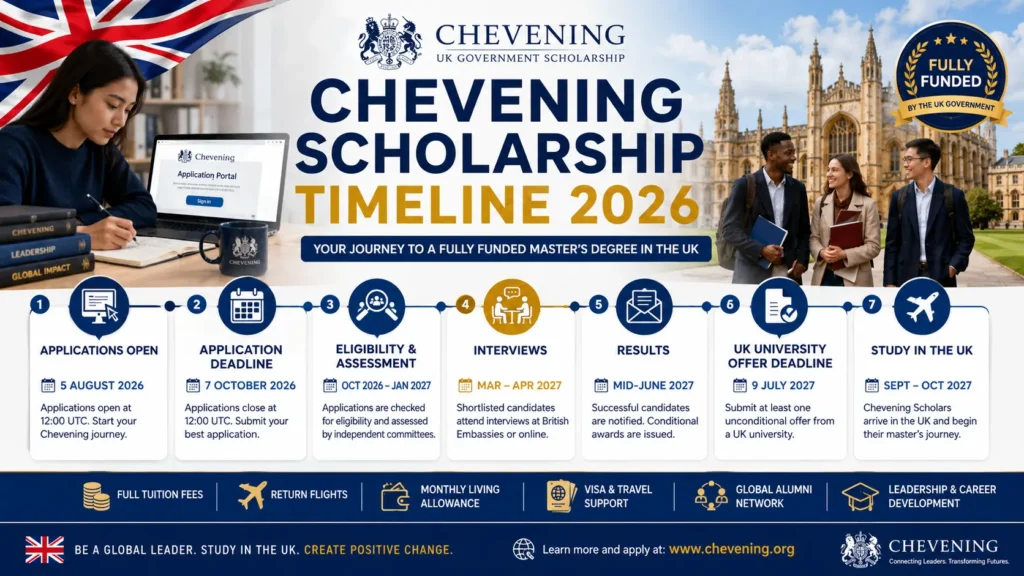
The Chevening Scholarship timeline is one of the most important things every applicant must understand before applying. Chevening follows a strict annual schedule, starting with applications in August, closing in October, shortlisting applicants in February, conducting interviews in March and April, announcing results from mid-June, and sending scholars to the UK in September or October.

For the 2025–2026 Chevening Scholarship cycle, applications opened on 5 August 2025 and closed on 7 October 2025 at 12:00 UTC. Shortlisted candidates were invited to interviews in mid-February 2026, interviews took place from March to April 2026, final results are announced from mid-June 2026, and successful candidates must submit at least one unconditional UK university offer by 9 July 2026.

If you missed the 2025–2026 cycle, your next target should be the expected Chevening Scholarship 2027 cycle, which is likely to open around August 2026. You should use the months before applications open to prepare your essays, choose your three eligible UK courses, collect documents, contact referees, and review the full Chevening Scholarship requirements.

Chevening Scholarship Timeline 2025–2026 at a Glance

StageOfficial TimelineWhat Happens
Applications open5 August 2025Online application portal opens at 12:00 UTC
Applications close7 October 2025Deadline closes at 12:00 UTC/GMT
Eligibility screeningFrom October 2025Applications are checked against eligibility criteria
Reading committee assessmentMid-October 2025 to January 2026Eligible applications are reviewed by independent reading committees
Interview shortlistMid-February 2026Shortlisted applicants are invited to interview
InterviewsMarch to April 2026Interviews take place at British embassies and high commissions
ResultsFrom mid-June 2026Successful candidates are notified
Offer deadline9 July 2026Deadline to submit at least one unconditional UK university offer
Studies beginSeptember/October 2026Scholars travel to the UK and begin their master’s degree

What Is the Chevening Scholarship Timeline?

The Chevening Scholarship timeline is the full application and selection schedule for applicants who want to study a one-year master’s degree in the UK through Chevening.

The timeline usually includes:

  • Application opening date
  • Application deadline
  • Eligibility screening
  • Reading committee assessment
  • Interview shortlist announcement
  • Interview period
  • Results announcement
  • Unconditional offer deadline
  • Visa and pre-departure preparation
  • Arrival in the UK

Chevening is not a quick application. It is a long process that can take almost a full year from the opening of applications to the start of studies in the UK.

Before applying, you should also check the Chevening Scholarship eligibility criteria because missing one requirement can lead to rejection even if your essays are strong.

ChatGPT Image Jun 14 2026 02 35 09 PM

1. Chevening Applications Open: 5 August 2025

The 2025–2026 Chevening Scholarship application cycle opened on 5 August 2025 at 12:00 UTC.

This is the date when applicants were able to access the official online application portal through their country or territory page.

At this stage, applicants should already have prepared:

  • Personal details
  • Education history
  • Work experience information
  • Three UK master’s course choices
  • Leadership essay ideas
  • Networking essay ideas
  • Career plan
  • Referee details

A serious applicant should not wait until applications open to start preparing. By August, your course research and essay planning should already be in progress.

If you are preparing for the next cycle, start by reviewing the Chevening Scholarship application process.

2. Chevening Application Deadline: 7 October 2025

The deadline for the 2025–2026 cycle was 7 October 2025 at 12:00 UTC/GMT.

This deadline is strict.

After the deadline, the online application system closes and applicants cannot access the portal to submit a late application.

This is why applicants should never wait until the final day. Technical problems, internet issues, missing information, or incomplete essays can cause unnecessary stress.

A good strategy is to submit at least several days before the deadline.

Chevening Deadline Time Zone Warning

Chevening deadlines are usually given in UTC or UK time.

This matters because 12:00 UTC may be a different time in your country.

For example, if you are applying from Pakistan, India, Nigeria, Bangladesh, Kenya, or Indonesia, you must convert the official deadline into your local time.

Do not assume the deadline means midnight in your country.

Missing the deadline by even a few minutes can mean losing your chance for the entire year.

For full deadline preparation, read our Chevening Scholarship deadline guide.

3. Eligibility Screening: From October 2025

After applications close, Chevening begins checking applications against eligibility criteria.

This stage removes applications that do not meet the basic rules.

Common eligibility issues include:

  • Not being from a Chevening-eligible country or territory
  • Not having an eligible undergraduate degree
  • Not meeting the work experience requirement
  • Choosing ineligible courses
  • Missing required information
  • Not meeting return-home commitment rules

Chevening requires applicants to have at least 2,800 hours of eligible post-graduation work experience.

If you are unsure how your work experience counts, read our detailed Chevening Scholarship work experience guide.

4. Reading Committee Assessment: Mid-October 2025 to January 2026

From mid-October 2025 to January 2026, independent reading committees assess eligible applications.

This is one of the most important parts of the Chevening timeline.

At this stage, your essays are reviewed carefully.

The reading committee usually looks for:

  • Leadership potential
  • Networking ability
  • Clear career goals
  • Strong UK study plan
  • Real professional impact
  • Evidence-based examples
  • Alignment with Chevening’s mission

Many applicants fail at this stage because their essays are too generic.

A weak essay says:

“I want to become a future leader and help my country.”

A stronger essay says:

“I led a district-level youth employment project that trained 240 graduates and helped 63 secure paid internships. My goal is to study public policy in the UK and return to improve youth employment programmes through evidence-based policy design.”

Specific examples are much stronger than general claims.

For essay structure, use our Chevening Scholarship essays guide.

5. Interview Shortlist: Mid-February 2026

In mid-February 2026, shortlisted applicants are contacted and invited to interviews.

This is a major milestone.

If you receive an interview invitation, it means your written application was strong enough to pass the reading committee stage.

However, being shortlisted does not guarantee final selection.

At this stage, you should immediately begin preparing for:

  • Leadership questions
  • Networking questions
  • Course choice questions
  • Career plan questions
  • Home country impact questions
  • Why UK questions
  • Why Chevening questions

You should also review your submitted application carefully because interview panels often ask questions based on your essays.

For interview preparation, read our Chevening Scholarship interview guide.

6. Document Upload Before Interview

Candidates invited to interview must upload required documents at least seven working days before their interview date.

Documents normally include:

  • Photo ID
  • Undergraduate education certificate or diploma
  • Reference letters
  • Other documents requested by Chevening or your local British embassy/high commission

Do not wait until the last week to collect documents.

If your degree certificate, transcript, or references are delayed, your interview process may become stressful.

You should contact your referees early and explain the timeline clearly.

7. Chevening Interviews: March to April 2026

Chevening interviews take place from March to April 2026.

Interviews are conducted by panels at British embassies and high commissions. Depending on country and circumstances, interviews may be in person or virtual.

The interview is usually designed to test whether your application is authentic, realistic, and aligned with Chevening’s goals.

Common interview themes include:

  • Tell us about your leadership experience.
  • Why did you choose these UK courses?
  • How will this degree help your career plan?
  • How will you contribute to your country after returning?
  • How have you built professional networks?
  • Why Chevening and not another scholarship?
  • What challenges exist in your sector?
  • How will you use the Chevening alumni network?

A strong interview answer is clear, direct, and based on real experience.

Avoid memorising robotic answers. The panel wants to hear your real story, not a copied template.

8. Chevening Results: From Mid-June 2026

Chevening results are announced from mid-June 2026 onwards.

Successful candidates may receive a conditional or confirmed scholarship status depending on whether they have already met all requirements.

If selected, you must continue completing the remaining steps, including university offer submission, visa preparation, and pre-departure requirements.

If you are not selected, remember that many applicants apply again and improve their application in the next cycle.

You can also read our guide on Chevening Scholarship success rate to understand how competitive the process is.

9. Unconditional Offer Deadline: 9 July 2026

Successful interview candidates must submit at least one unconditional offer from a UK university by 17:00 BST on 9 July 2026.

This is one of the most important deadlines in the entire Chevening timeline.

If you fail to secure an unconditional offer by the deadline, you may lose your scholarship opportunity even if your interview was successful.

This is why you should apply to universities early.

You do not need to have an unconditional offer when you submit the initial Chevening application, but you must secure one by the official offer deadline.

For choosing courses, read our Chevening Scholarship courses guide.

10. September/October 2026: Studies Begin in the UK

Successful Chevening Scholars begin their studies in the UK in September or October 2026.

Before departure, scholars usually prepare:

  • Visa documents
  • Travel arrangements
  • Accommodation
  • University registration
  • Budget planning
  • Packing list
  • Pre-departure events
  • Scholarship paperwork

Chevening is more than a scholarship. Scholars join a global network of future leaders, professionals, policymakers, entrepreneurs, researchers, and changemakers.

You can learn more about the funding package in our Chevening Scholarship stipend guide and Chevening Scholarship amount guide.

Chevening Scholarship 2027: Expected Timeline

If you missed the 2025–2026 application cycle, your next target is likely the Chevening Scholarship 2027 cycle.

Official dates for the next cycle should always be checked on the official Chevening website, but based on previous patterns, applications are expected to open around August 2026.

A likely timeline may look like this:

Expected StageEstimated Timeline
Applications openAugust 2026
Applications closeOctober 2026
Eligibility screeningOctober 2026 onward
Reading committee assessmentsOctober 2026 to January 2027
Interview shortlistFebruary 2027
InterviewsMarch to April 2027
ResultsJune 2027
Offer deadlineJuly 2027
Studies beginSeptember/October 2027

This timeline is an estimate until Chevening officially confirms the dates.

How to Prepare Before Chevening Applications Open

The best Chevening applicants prepare months before the application portal opens.

Here is what you should do before August.

Research Three Eligible UK Courses

Chevening requires applicants to choose three eligible UK master’s courses.

Your course choices should be:

  • Full-time
  • Taught master’s degrees
  • Based in the UK
  • Starting in the correct academic year
  • Relevant to your career plan
  • Connected to your leadership goals

Do not choose courses only because a university is famous.

Choose courses because their modules, teaching style, research strengths, and career outcomes support your future plan.

Prepare Your Leadership Examples

Chevening looks for leadership potential.

Leadership can come from:

  • Workplace projects
  • Community initiatives
  • Volunteer work
  • Policy involvement
  • Social impact campaigns
  • Entrepreneurship
  • Student organisations
  • Professional networks

Write down examples where you:

  • Identified a problem
  • Took action
  • Influenced people
  • Managed challenges
  • Created measurable impact

Strengthen Your Networking Story

Networking is a major part of Chevening.

You should prepare examples that show how you built relationships and used them to create results.

Strong networking examples include:

  • Collaborating with organisations
  • Building partnerships
  • Connecting communities
  • Working with mentors
  • Coordinating stakeholders
  • Joining professional groups
  • Creating opportunities through relationships

Build a Clear Career Plan

Your career plan should answer:

  • What do you want to do after returning home?
  • Which sector will you work in?
  • Which problem will you solve?
  • Why do you need a UK master’s degree?
  • How will Chevening help?
  • What impact will you create in five to ten years?

A vague plan weakens your application.

A specific plan improves your chances.

Contact Referees Early

Do not choose referees at the last minute.

Good referees should know your work, leadership ability, character, and achievements.

Before listing someone as a referee, ask them:

  • Are you willing to support my Chevening application?
  • Can you write a strong reference?
  • Can you submit it before the deadline if required?
  • Can you describe my leadership and professional impact?

Prepare Documents Early

You should prepare:

  • Passport or national ID
  • Undergraduate degree certificate
  • Academic transcript
  • CV or résumé
  • Work experience details
  • Referee information
  • University course list
  • Personal achievements
  • Leadership examples

If your documents need translation, start early.

Common Chevening Timeline Mistakes

Many applicants lose time or weaken their application because they misunderstand the timeline.

Avoid these mistakes:

  • Waiting until applications open to start essays
  • Submitting on the final day
  • Ignoring UTC deadline time
  • Choosing random UK courses
  • Not applying to universities early
  • Contacting referees too late
  • Forgetting document upload deadlines
  • Preparing for interview only after shortlist
  • Missing the unconditional offer deadline
  • Assuming dates stay exactly the same every year

Do You Need IELTS Before Applying for Chevening?

Chevening itself does not usually require IELTS during the initial scholarship application.

However, your chosen UK universities may require proof of English language ability.

This means you should check each university’s requirements early.

Some universities may accept:

  • IELTS
  • TOEFL
  • PTE
  • Previous English-medium education
  • University-specific English tests
  • Waiver based on country or prior study

Do not wait until the offer deadline to check English requirements.

Should You Apply to Universities Before Chevening Results?

Yes, it is often smart to apply to universities early.

You do not need an unconditional offer at the time of initial Chevening application, but you must submit at least one unconditional offer by the official deadline if selected.

Applying early gives you more time to:

  • Meet English requirements
  • Submit documents
  • Handle university delays
  • Compare course offers
  • Avoid last-minute panic

What Happens If You Miss the Chevening Deadline?

If you miss the application deadline, you cannot apply for that cycle.

Chevening deadlines are strict.

You will need to wait for the next cycle.

This is why you should set multiple reminders:

  • One month before deadline
  • Two weeks before deadline
  • One week before deadline
  • Three days before deadline
  • One day before deadline

Final Thoughts

The Chevening Scholarship timeline is strict, structured, and highly competitive.

For the 2025–2026 cycle, applications opened on 5 August 2025 and closed on 7 October 2025. Interviews took place from March to April 2026, results are announced from mid-June 2026, the university offer deadline is 9 July 2026, and scholars begin their UK studies in September or October 2026.

If you are planning for Chevening Scholarship 2027, do not wait for applications to open. Start preparing now.

Research your courses, build your leadership examples, contact referees, prepare documents, and write essays early.

A strong Chevening application is not created in one week. It is built through planning, clarity, and careful preparation.

Frequently Asked Questions

When did Chevening Scholarship 2025–2026 applications open?

Chevening Scholarship applications for the 2025–2026 cycle opened on 5 August 2025 at 12:00 UTC.

When did Chevening Scholarship 2025–2026 applications close?

Applications closed on 7 October 2025 at 12:00 UTC/GMT.

When are Chevening interviews held?

For the 2025–2026 cycle, interviews take place from March to April 2026.

When are Chevening results announced?

Chevening results are announced from mid-June 2026 onwards.

What is the Chevening offer deadline for 2026?

The deadline to submit at least one unconditional UK university offer is 17:00 BST on 9 July 2026.

When do Chevening Scholars start studying in the UK?

Scholars begin their studies in the UK in September or October 2026.

When will Chevening Scholarship 2027 open?

Official dates are not confirmed yet, but based on previous timelines, the next cycle is expected to open around August 2026.

Is the Chevening deadline the same for every country?

The global scholarship deadline is usually the same, but applicants should always check their country or territory page for specific instructions.

Can I submit my Chevening application after the deadline?

No. Late applications are not accepted after the online system closes.

Do I need a university offer before applying for Chevening?

No, you do not usually need an offer before submitting the initial Chevening application. However, if selected, you must submit at least one unconditional UK university offer by the official offer deadline.

Should I apply to universities before Chevening results?

Yes. Applying early is recommended because university admissions can take time.

How many courses do I need to choose for Chevening?

You need to choose three eligible UK master’s courses.

What documents are needed before the Chevening interview?

Interview candidates must upload required documents such as photo ID, undergraduate education certificate or diploma, and references at least seven working days before the interview.

What happens after Chevening interviews?

After interviews, final results are announced from mid-June onwards. Successful applicants then complete offer, visa, and pre-departure steps.

Can I prepare for Chevening before applications open?

Yes. You should prepare essays, course choices, documents, referees, and career plans before applications open.

Is Chevening open for 2026 applications now?

The 2025–2026 application window has closed. Applicants should check the official Chevening website for the next cycle.

What is the Chevening Scholarship 2027 deadline?

The official 2027 deadline has not been announced yet. Based on previous cycles, it may fall around October 2026, but applicants must confirm on the official Chevening website.

Does Chevening Fellowship follow the same timeline?

No. Chevening Fellowship timelines may vary. This timeline is for Chevening Scholarship applicants only.

What is the most important Chevening deadline?

The application deadline is the first major deadline. For shortlisted candidates, the document upload, interview, and unconditional offer deadlines are also critical.

How long is the Chevening application process?

The process can take around 12 to 14 months from application opening to starting studies in the UK.

Filed Under: GUIDES

The Ultimate Guide to Chevening Alumni Resources: Maximizing Your Network After Graduation

October 17, 2025 by Amina Shah

Here’s a truth that nobody tells you when you’re celebrating your UK graduation: the real Chevening experience doesn’t end when you collect your diploma. It actually begins.

I know what you’re thinking. You’ve just spent a year juggling lectures, essays, networking events, and trying to experience as much of the UK as humanly possible on a student budget. You’re exhausted. You’re ready to head home and apply everything you’ve learned. And now I’m telling you that you’re not done?

Not quite. What I’m saying is this: that graduation certificate you’re holding isn’t just proof of academic achievement. It’s your lifetime membership card to one of the world’s most powerful professional networks—and most graduates have no idea how to use it.

The alumni resources available to Chevening graduates are vast, underutilized, and potentially career-changing. But here’s the catch: they don’t come with an instruction manual. Nobody hands you a “How to Be a Successful Chevening Alumnus” guidebook as you board your flight home.

So let’s fix that. Consider this your comprehensive guide to navigating, leveraging, and maximizing every opportunity the Chevening alumni network offers.

Understanding the Chevening Alumni Network

Before we dive into specific resources, let’s talk about what you’ve actually joined. The Chevening alumni network isn’t some abstract concept or a LinkedIn group that sends occasional spam. It’s a living, breathing global community of over 55,000 leaders across more than 160 countries.

Think about that number for a moment. 55,000 people who’ve been through exactly what you’ve experienced. They’ve navigated the same application stress, survived the same British winter, questioned whether they truly understood their professor’s accent, and returned home determined to make a difference.

These aren’t just alumni—they’re current ministers, ambassadors, supreme court judges, leading journalists, successful entrepreneurs, influential academics, and change-makers across every sector imaginable. And they’re all part of your network now.

The Chevening alumni programme is structured around a simple but powerful idea: your scholarship wasn’t just about your personal development. It was an investment in collective leadership capacity. The Foreign, Commonwealth & Development Office (FCDO) funded your education expecting not just that you’d succeed individually, but that you’d collaborate, support each other, and amplify each other’s impact.

This means the alumni resources aren’t extras or perks—they’re integral to what Chevening is trying to achieve. Using them isn’t optional if you’re serious about maximizing the opportunity you’ve been given.

The Alumni Benefits You Didn’t Know You Had

Let’s start with the basics. What alumni benefits are actually available to you as a Chevening graduate?

Lifetime Network Access

Your access to the Chevening network doesn’t expire. Ever. Whether you graduated last year or twenty years ago, you remain part of the community. This means:

  • Access to the global alumni database (once you’ve registered)
  • Invitations to alumni events, both in your country and globally
  • Eligibility for alumni-specific opportunities and funding
  • Connection to new scholars each year
  • Continued relationship with British embassies and high commissions

Career Support Services

The alumni career support infrastructure includes:

  • Job opportunities shared through the network
  • Career coaching and mentoring programs
  • Professional development webinars and workshops
  • Access to leadership training programs
  • Connections to UK and international employers seeking Chevening talent

Funding Opportunities

Through the Chevening Alumni Programme Fund and other mechanisms, alumni can access:

  • Project funding for impact initiatives
  • Support for entrepreneurial ventures
  • Grants for collaborative alumni projects
  • Seed funding for community development programs
  • Financial support for continuing education

Platform and Visibility

Chevening actively promotes alumni achievements through:

  • Alumni spotlight features on official channels
  • Speaking opportunities at Chevening events
  • Representation at international forums
  • Media connections for thought leadership
  • Platforms to share your impact stories

Continued UK Connections

Your relationship with the UK doesn’t end at graduation:

  • Some UK university resources remain accessible to alumni
  • Connections to British institutions relevant to your field
  • Opportunities to return to the UK for short-term fellowships or programs
  • Links to UK organizations working in your sector
  • Ongoing diplomatic relationships through embassies

Navigating the Alumni Resource Portal

The alumni resource portal is your gateway to everything Chevening offers post-graduation. But like any portal, it’s only useful if you know how to navigate it.

Getting Started

First things first: if you haven’t already registered in the alumni database, do it now. Seriously, put this article down and register. I’ll wait.

The registration process requires:

  • Your basic contact information
  • Your current employment details
  • Your social media profiles (particularly LinkedIn)
  • Your areas of expertise and interest
  • Your willingness to participate in various alumni activities

Why does all this matter? Because the database isn’t just a directory—it’s how Chevening matches opportunities to alumni. Grant opportunities in environmental policy? They search the database for alumni working in that field. Need a speaker on digital innovation? They search for alumni with that expertise.

If your profile is incomplete or outdated, you’re invisible to these opportunities.

Key Portal Features

Once you’re registered, familiarize yourself with these essential features:

Events Calendar: Lists upcoming alumni events and conferences globally. These range from major international conferences to local networking meetups.

Opportunities Board: Where alumni job opportunities, grant applications, speaking invitations, and collaboration proposals are posted.

Resource Library: Access to toolkits, best practice guides, impact reports, and professional development materials.

Alumni Directory: Searchable database of fellow alumni (privacy settings apply). This is gold for finding alumni in your field, region, or with specific expertise.

Impact Sharing Platform: Where you can submit your own success stories and see what other alumni are achieving.

Communication Tools: Direct messaging, discussion forums, and group creation features.

The portal is constantly evolving. Chevening regularly adds new features based on alumni feedback, so explore it periodically rather than assuming you know everything it offers.

Alumni Networking: Beyond LinkedIn Connections

Let’s talk about alumni networking opportunities because this is where most people get it wrong. They connect on LinkedIn, send a few messages, and think they’re networking. That’s not networking—that’s digital bookmarking.

Real networking within the Chevening community looks different.

Regional Alumni Groups

Alumni regional chapters exist in most countries and major cities. These aren’t just social clubs (though the social element is valuable). They’re professional communities that:

  • Organize regular meetups and professional events
  • Coordinate local impact projects
  • Provide peer support and mentorship
  • Create job opportunities through member connections
  • Advocate for policy changes collectively
  • Support incoming Chevening scholars

Joining your local chapter should be one of your first post-graduation moves. These are the people who understand both the Chevening experience and your local professional context—an invaluable combination.

Sector-Specific Groups

Beyond geography, alumni professional groups organize around sectors and disciplines:

  • Health policy alumni
  • Media and journalism alumni
  • Environmental sustainability alumni
  • Legal and judicial reform alumni
  • Education and academic alumni
  • Technology and innovation alumni
  • Arts and culture alumni

These groups facilitate alumni research collaboration, knowledge sharing, and cross-country learning on sector-specific challenges. If you’re working in healthcare in Kenya, connecting with health policy alumni from Ghana, India, and the Philippines can provide comparative insights that transform your approach.

Virtual Communities

The alumni online community platforms have expanded dramatically, especially post-pandemic. Alumni social media groups on WhatsApp, Telegram, LinkedIn, and Facebook host thousands of active members sharing opportunities, asking questions, and supporting each other.

But here’s a networking tip: don’t just lurk. Contribute. Share your expertise. Answer questions. Post opportunities. The value you get from these communities directly correlates with the value you give.

Effective Alumni Networking Tips

Based on watching successful alumni networkers over the years, here’s what works:

Be Specific When Reaching Out: “I’d love to pick your brain” is vague and gets ignored. “I’m designing a maternal health program and noticed you led similar work in Uganda—could I ask three specific questions about stakeholder engagement?” gets responses.

Offer Before Asking: See an opportunity perfect for a fellow alumnus? Share it. Know someone who could help another alumnus? Make the introduction. Build social capital before you need to spend it.

Show Up Consistently: Attend alumni events regularly. Comment on posts. Participate in discussions. Visibility builds recognition, which builds relationships.

Follow Up and Follow Through: Met someone at an alumni event? Follow up within 48 hours. Promised to share a resource? Do it. Reliability is rare and valuable.

Think Long-Term: Don’t network only when you need something. Build relationships continuously, not transactionally.

Accessing Alumni Career Support

The alumni career support infrastructure is more sophisticated than most graduates realize. It’s not just a job board—it’s a comprehensive career development ecosystem.

Alumni Mentoring Programs

Alumni mentoring programs operate at multiple levels:

Peer Mentoring: Recent graduates mentored by alumni 3-5 years ahead in their careers. This provides practical, immediately applicable guidance on early-career challenges.

Senior Mentoring: Mid-career alumni mentored by senior leaders who’ve been in the network for 10+ years. This focuses on strategic career development and leadership positioning.

Sector Mentoring: Alumni in specific fields mentored by recognized leaders in those sectors, whether they’re alumni or not (Chevening facilitates these connections).

Reverse Mentoring: Senior alumni mentored by younger alumni on emerging trends, technology, or evolving professional contexts.

To access alumni professional mentorship, you typically need to:

  • Register your interest through the portal
  • Complete a profile explaining your career goals and challenges
  • Specify what kind of mentorship would be most valuable
  • Commit to the mentorship timeline and expectations

The best mentorships happen when you’re clear about what you need and ready to be an active participant, not a passive recipient.

Career Coaching Services

Alumni career coaching is available through several channels:

Virtual Workshops: Regular sessions on resume building, interview preparation, personal branding, salary negotiation, and career transitions.

One-on-One Coaching: Limited slots available for alumni at career crossroads or pursuing significant transitions.

Industry-Specific Guidance: Coaching tailored to particular sectors, especially for alumni entering new fields.

These services are often provided by professional career coaches or senior alumni with HR and recruitment experience.

Job Placement and Opportunities

While Chevening doesn’t guarantee employment (nothing does), the network provides significant advantages:

Alumni Job Boards: Organizations specifically seeking Chevening talent post opportunities directly to alumni. These employers understand Chevening’s selection criteria and trust the network’s quality.

Embassy and High Commission Positions: British diplomatic missions regularly recruit alumni for various roles.

International Organization Opportunities: Bodies like the UN, World Bank, and regional development banks value Chevening alumni and often circulate opportunities through the network.

Private Sector Connections: Companies operating internationally, particularly UK businesses expanding into emerging markets, seek alumni who understand both UK professional standards and local contexts.

Entrepreneurial Support: For alumni building their own ventures, alumni entrepreneurial support includes connections to investors, business mentorship, and sometimes seed funding.

Leadership Development for Alumni

Alumni leadership development doesn’t stop at graduation. In fact, it often accelerates.

Advanced Leadership Training

Chevening regularly offers alumni-specific leadership programs:

Regional Leadership Workshops: Intensive multi-day programs bringing together alumni from specific regions to tackle shared leadership challenges.

Sector Leadership Programs: Deep-dive training for alumni leading change in particular sectors (governance, education, health, environment, etc.).

Executive Education Opportunities: Occasional partnerships with UK business schools offer alumni access to executive education programs at reduced cost or on scholarship.

Virtual Leadership Series: Online programs covering topics like leading through crisis, digital transformation, managing diverse teams, and strategic communication.

The Alumni Ambassador Program

Becoming an alumni ambassador is one of the highest-impact ways to engage with Chevening post-graduation. Alumni ambassador programs involve:

Recruitment Support: Speaking at Chevening information sessions, advising potential applicants, and conducting pre-departure orientations for incoming scholars.

Profile Raising: Representing Chevening at conferences, in media, and at public events.

Network Building: Strengthening alumni communities in your region and facilitating connections.

Feedback Provision: Advising Chevening on program improvements based on alumni and scholar experiences.

Ambassadors receive training, visibility, and often funding for their activities. More importantly, they develop skills in public speaking, program management, and community building while giving back to the scholarship that supported them.

The Chevening Alumni Programme Fund

Let’s talk money. The Chevening Alumni Programme Fund is probably the most underutilized alumni resource, primarily because people don’t understand what it is or how to access it.

What the Fund Supports

The Alumni Programme Fund provides grants for alumni-led projects that:

  • Address development challenges in your home country
  • Demonstrate UK-home country collaboration
  • Engage multiple alumni (collaborative projects are prioritized)
  • Create measurable impact
  • Align with UK government priorities and your country’s development needs

Typical funded projects include:

Professional Training Programs: Alumni designing and delivering training for professionals in their sectors.

Policy Research and Advocacy: Evidence-gathering projects that inform policy decisions.

Community Development Initiatives: Projects addressing local challenges through innovative approaches.

Knowledge Exchange Programs: Facilitating learning between UK institutions and organizations in alumni home countries.

Network-Building Events: Large-scale conferences or workshops that strengthen professional communities.

Application Process

Alumni grant application tips based on successful applicants:

Start with Clear Objectives: What specific change will your project create? Vague goals like “raise awareness” don’t cut it. Specific outcomes like “train 100 teachers in digital literacy” do.

Budget Realistically: The fund supports modest projects (typically a few thousand pounds). Don’t propose something requiring £50,000 in funding. Design something impactful within realistic budget constraints.

Demonstrate Sustainability: How will the project continue or replicate after grant funding ends? Sustainability is weighted heavily in selection.

Show Collaboration: Projects involving multiple alumni, or partnerships between alumni and UK institutions, score better than solo efforts.

Provide Evidence: Use data, research, and case studies to justify your approach. Show you’ve thought deeply about the problem and solution.

Follow Guidelines Precisely: Every fund cycle has specific application requirements and deadlines. Meet them exactly.

Applications typically open once or twice yearly, with announcements through the alumni portal and email. The competition is significant, so quality matters.

Continuing Education and Professional Development

Alumni continuing education opportunities extend far beyond the master’s degree you’ve just completed.

Online Learning Access

Many alumni don’t realize they may still have access to:

UK University Alumni Resources: Some universities provide library access, online databases, and learning platforms to alumni. Check with your UK university about what remains available.

Chevening-Negotiated Platforms: Occasionally, Chevening negotiates discounted or free access to online learning platforms (like Coursera, LinkedIn Learning, or FutureLearn) for alumni.

Professional Association Memberships: Alumni working in certain fields may be eligible for reduced-fee memberships in UK professional bodies.

Short Courses and Certifications

Alumni digital skills training and other professional development often happens through:

Alumni-Led Workshops: Alumni with specific expertise offering training to fellow alumni.

Partnership Programs: UK institutions offering short courses to Chevening alumni at discounted rates.

Virtual Learning Series: Regular webinars and online courses on emerging topics.

Research and Academic Collaboration

For alumni in research-oriented careers, alumni research collaboration opportunities include:

Joint Research Projects: Connecting alumni researchers with UK academics for collaborative studies.

Conference Participation: Speaking slots at UK academic conferences.

Publication Opportunities: Platforms to publish research and thought leadership.

Visiting Fellowships: Occasional opportunities to return to UK universities for short-term research visits.

Making and Sharing Your Impact

The Alumni Charter outlines mutual expectations between Chevening and its alumni. One key expectation: you’ll create positive change and share your impact.

Why Impact Sharing Matters

“Share your impact” isn’t just feel-good marketing. It serves multiple purposes:

Accountability: You’re more likely to maintain focus on impact when you know you’ll report on it.

Learning: Other alumni learn from your successes and failures, accelerating collective progress.

Visibility: Demonstrating impact increases your professional profile and opens doors.

Advocacy: Collective alumni impact justifies continued Chevening funding and expansion.

Inspiration: Your story might inspire another alumnus or a prospective applicant.

How to Share Your Impact

The alumni impact stories platform accepts submissions in various formats:

Written Case Studies: Detailed narratives of projects, initiatives, or career achievements.

Video Testimonials: Short videos explaining your work and its impact.

Photo Essays: Visual documentation of your initiatives.

Data Dashboards: For alumni tracking quantitative impact metrics.

Media Features: Sharing media coverage of your work.

Don’t wait until you’ve “achieved something huge.” Small, consistent impacts are valuable too. Trained 20 people? That’s impact. Changed one policy? That’s impact. Started a conversation that led to change? That’s impact.

Regional Variations in Alumni Resources

Not all alumni resources are identical across countries. Alumni regional chapters have autonomy to design programming that fits local contexts.

High-Activity Regions

Some countries have particularly active and well-resourced alumni communities:

Pakistan: Regular professional development events, active mentorship programs, and strong collaboration with British High Commission.

Nigeria: Large network with sector-specific subgroups, annual conferences, and significant alumni entrepreneurial support.

India: Extensive regional chapters, high-profile alumni ambassador program, and strong connections to both private sector and government.

Malaysia: Innovative digital engagement strategies and active virtual community.

Kenya: Strong focus on development impact and community projects.

Brazil: Growing network with increasing focus on research collaboration.

Building Your Regional Network

If your country’s alumni network is less active, see this as opportunity rather than disadvantage. You could be the person who strengthens it. Consider:

Starting a Local Chapter: Contact Chevening about establishing or revitalizing your regional group.

Organizing an Event: Even a small gathering can kickstart momentum.

Creating Online Spaces: WhatsApp groups, LinkedIn networks, or virtual meetups for geographically dispersed alumni.

Collaborating with the Embassy: British embassies often welcome alumni initiative and can provide support.

Maintaining Long-Term Engagement

Here’s the uncomfortable truth: most alumni are highly engaged for the first year after graduation, moderately engaged for years 2-3, and then drift away. By year 5, many have lost touch with the network entirely.

This is a massive missed opportunity.

Staying Connected Long-Term

Update Your Details Regularly: That alumni database is useless if your information is five years out of date. Update your profile whenever you change jobs, move, or reach new milestones.

Engage on Your Terms: You don’t have to attend every event or join every initiative. Find your niche—maybe you’re passionate about mentoring but uninterested in conferences. That’s fine. Engage where it’s meaningful to you.

Create Rituals: Decide on regular touchpoints with the network. Maybe you attend one alumni event per quarter, or check the opportunities board every month, or mentor one scholar annually. Rituals prevent drift.

Bring Others In: Introduce colleagues to the network when appropriate. Facilitate connections between alumni and your professional contacts. The network grows stronger when it’s not insular.

Give Before Taking: As you advance in your career, remember to give back. The senior alumni who help you today were once in your shoes. Pay it forward.

Chevening Scholarship in Algeria: Providing Top-Notch Education for Building Future Leaders 

The Alumni Association Toolkit

For alumni interested in formal leadership within the network, the Alumni Association Toolkit provides resources for:

Event Planning: Templates, best practices, and checklists for organizing alumni networking events.

Communications: Newsletter templates, social media strategies, and engagement campaigns.

Fundraising: Guidance on fundraising for alumni projects and initiatives.

Governance: Structures for formal alumni associations, including constitutions, officer roles, and election processes.

Impact Measurement: Tools for tracking and demonstrating alumni community impact.

This toolkit is particularly valuable if you’re starting or leading a regional chapter, planning a major event, or proposing a significant alumni initiative.

UK Funded Chevening Scholarship in Antigua and Barbuda

Frequently Asked Questions About Alumni Resources

How soon after graduation can I access alumni resources?

Immediately. Your access begins as soon as your scholarship period ends. In fact, you should be registering in the alumni database before you even leave the UK.

Do I need to pay membership fees to access alumni resources?

No. All core alumni resources are free. However, some specific events or programs might have participation fees to cover costs.

Can I access alumni resources if I’m no longer working in my home country?

Yes. Your geographic location doesn’t affect your alumni status or access to resources, though you might find regional programming more relevant to wherever you’re currently based.

How do I balance using alumni resources with my busy professional life?

Start small. Pick one or two resources most relevant to your immediate needs rather than trying to engage with everything. As you see value, you’ll naturally expand engagement.

Are there alumni resources specifically for entrepreneurs?

Yes. Alumni entrepreneurial support includes mentorship from alumni entrepreneurs, connections to investors, and sometimes seed funding through the Alumni Programme Fund for ventures with social impact.

Can current scholars access alumni resources?

Not typically. Alumni resources are for graduates. However, current scholars can attend some alumni events and connect with alumni through mentorship programs.

What if I can’t find alumni in my specific field or region?

Use the alumni directory to search broader—maybe there aren’t maritime law alumni in your city, but there are legal professionals. Cast your net wider initially, then help build the specific community you’re seeking.

How formal is alumni networking—do I need to attend events in business attire?

It varies. Major conferences and embassy events tend toward business formal. Regional meetups are often business casual. Virtual events are typically casual. When in doubt, check the event description or ask organizers.

Can I invite non-alumni to alumni events I’m organizing?

Usually yes, especially for large public events. However, check with Chevening or your regional coordinator about any restrictions on specific programs or resources that should remain alumni-only.

What happens if I don’t engage with alumni resources for several years—can I rejoin?

Absolutely. Your alumni status is permanent. You can re-engage at any time by updating your database profile and starting to participate again. The network welcomes returning alumni.

Chevening Scholarship in Anguilla, UK Fully Funded Opportunity

Success Stories: Alumni Resources in Action

Let me share some alumni networking success stories that illustrate the power of these resources:

Amara (Nigeria, 2018) used the alumni mentorship program to connect with a senior alumnus working in fintech regulation. That mentorship led to her appointment as a policy advisor in her country’s central bank, a role that didn’t exist until she and her mentor proposed it.

Roberto (Brazil, 2015) accessed the Alumni Programme Fund to organize a regional conference on climate adaptation. The conference connected 200 professionals from across Latin America and resulted in a research consortium that’s now influencing regional climate policy.

Fatima (Pakistan, 2019) leveraged alumni networking opportunities to find collaborators for her health tech startup. She’s now working with alumni from three countries, and her app serves 50,000 users.

James (Kenya, 2016) became an alumni ambassador and now mentors 5-6 applicants each year. His engagement led to a role as a Chevening selection committee member, and he’s become a recognized voice on education policy in his country.

Maria (Colombia, 2017) used alumni continuing education resources to complete additional certifications in data science. She credits the alumni network with connecting her to the opportunity and the Alumni Programme Fund with partially funding her certification.

These aren’t outliers. They’re examples of what’s possible when you engage seriously with available resources.

UK Government´s Fully Funded Chevening Scholarships in Argentina

Making the Most of Your Alumni Experience

As we wrap up this comprehensive guide, let’s distill everything into actionable steps:

Immediate Actions (Within 1 Month of Graduation):

  • Register in the alumni database with complete information
  • Join your regional alumni chapter
  • Connect with 10-15 fellow alumni on LinkedIn
  • Attend your first alumni event or webinar
  • Explore the alumni portal thoroughly

Short-Term Actions (Months 2-6):

  • Apply for the Alumni Programme Fund if you have a project idea
  • Join sector-specific alumni groups relevant to your work
  • Engage with at least one mentorship opportunity (as mentor or mentee)
  • Update your database profile with any career changes
  • Share an early impact story, even if modest

Medium-Term Actions (Year 1-2):

  • Attend a major alumni conference if possible
  • Consider becoming an alumni ambassador
  • Collaborate with at least one other alumnus on a professional project
  • Contribute actively to online alumni communities
  • Mentor incoming or prospective Chevening scholars

Long-Term Actions (Year 3+):

  • Take on leadership within your regional chapter if interested
  • Leverage the network for significant career transitions or initiatives
  • Share substantive impact stories demonstrating long-term change
  • Give back by mentoring newer alumni
  • Stay connected even as your career advances

The Real Value of Alumni Resources

Here’s what I’ve learned from watching successful Chevening alumni over the years: the ones who maximize their experience don’t treat alumni resources as transactional perks. They treat them as infrastructure for lifelong professional growth and collective impact.

They understand that every connection made, every event attended, every resource utilized is an investment that compounds over time. The alumni you mentor today might hire you tomorrow. The regional chapter you help build creates opportunities for hundreds of future alumni. The impact story you share inspires someone else’s initiative.

The Chevening alumni resources aren’t just about what you can get—they’re about what we can build together. They’re recognition that the challenges you’re trying to address—whether in healthcare, governance, education, environment, or any other field—are too big for individual heroics. They require networks, collaboration, and sustained collective effort.

Your Chevening scholarship gave you world-class education, UK experience, and a prestigious credential. But the alumni network gives you something potentially more valuable: a lifelong professional community invested in your success and in creating positive change.

The question isn’t whether these resources are valuable. The question is whether you’ll use them.

Fully Funded Chevening Scholarships in Armenia’s Visionary Leaders

Your Next Steps

If you’re a recent graduate reading this, update your alumni database profile today. Right now. Before you forget or get distracted by other priorities.

If you graduated a few years ago and haven’t engaged much, attend one alumni event this month. Just one. See what happens.

If you’re a long-time alumnus who’s drifted away, reach out to your regional chapter coordinator and ask how you can plug back in.

And if you’re currently a Chevening scholar preparing to graduate, bookmark this guide. You’ll need it soon.

The Chevening alumni network is one of your most valuable career assets. But like any asset, it only creates value if you actually use it.

Your UK degree certificates are hanging on your wall. Your Chevening experience is documented in photos and memories. But your alumni network is alive, growing, and waiting for you to engage with it.

The resources are there. The opportunities are real. The network is powerful.

What you do with all of it is entirely up to you.

Ready to maximize your Chevening alumni experience? Log into the alumni portal, update your profile, and explore available resources. Your next career breakthrough might be just one alumni connection away.

Filed Under: GUIDES

Chevening Travel Allowance: Your Complete Guide to Flying to the UK

October 15, 2025 by Amina Shah

You’ve just received that life-changing email. Congratulations, you’re a Chevening Scholar! The celebrations are underway, you’ve told everyone you know, and then reality hits—wait, how exactly do I get to the UK? What does this travel allowance actually cover? Can I bring my family? And why are there so many emails about booking agencies?

I get it. The Chevening travel allowance can feel like navigating a maze blindfolded. But here’s the thing: once you understand how it works, it’s actually pretty straightforward. Let me walk you through everything you need to know about getting yourself to the UK without the headache.

What Exactly Is the Chevening Travel Allowance?

Let’s start with the basics. The Chevening travel allowance is your ticket—quite literally—to the United Kingdom. It’s the funding that covers your flights from your home country to the UK at the start of your scholarship, and then back home again once you’ve wrapped up your master’s degree.

Think of it as Chevening’s way of saying, “We’ll handle the logistics of getting you here, so you can focus on preparing for the academic adventure ahead.”

Now, here’s what you need to know upfront: this isn’t a cash-in-hand situation where you get money to spend however you like. Instead, Chevening works with designated travel agencies who book your flights according to specific policies. It’s organized, it’s efficient, but yes, it comes with rules.

How Much Is the Chevening Travel Allowance Actually Worth?

I know what you’re thinking—give me the numbers. Unfortunately, there’s no one-size-fits-all answer here. The travel allowance amount varies depending on where you’re flying from. Someone traveling from Kenya will have a different allowance than someone coming from Chile or Indonesia.

The allowance is calculated to cover an economy class return ticket from your home country to the UK. Chevening uses market rates and works with travel agencies to ensure the funding is realistic for your route. You’ll receive specific information about your travel allowance in your award letter and subsequent communications from the Chevening Secretariat.

Here’s the clever bit: you don’t need to stress about finding the cheapest flight or gaming the system. The designated travel agency handles the booking, and the costs are covered within your allocated allowance.

The Chevening Travel Policy: What You Need to Know

Let me be real with you—understanding the Chevening travel policy is essential. It’s not complicated, but there are specific guidelines you need to follow.

Economy Class Only

First up: you’re flying economy. I know, I know—we all dream of turning left when boarding the plane. But Chevening covers economy class flights only. No upgrades to premium economy, business, or first class, even if you’re willing to pay the difference out of pocket.

The reasoning? It’s about fairness and ensuring scholarship funds are used efficiently. Every scholar, regardless of their flight distance, travels in the same class.

Using the Designated Travel Agency

Here’s where things get interesting. You can’t just hop onto Skyscanner, find a bargain, and book it yourself. Chevening requires you to use their designated travel booking agency. This agency will contact you once you’ve been confirmed as a scholar.

Why the restriction? It’s about control and accountability. By using approved agencies, Chevening ensures scholars aren’t stranded with invalid tickets, flights are properly documented, and everyone receives consistent service.

Booking Timeline

Timing matters. You’ll typically receive instructions about booking your flights several months before your course starts. Pay attention to these deadlines—missing them can complicate your arrival arrangements.

The usual process looks something like this:

  1. You receive your visa clearance
  2. The travel agency contacts you with booking instructions
  3. You provide your travel preferences and dates
  4. The agency books your flights
  5. You receive your tickets and itinerary

The Chevening Flight Booking Process: Step by Step

Let me walk you through what actually happens when you book your Chevening flight, because knowing what to expect makes everything less stressful.

Step 1: Wait for Contact

After accepting your scholarship, you’ll receive communication from Chevening’s designated travel agency. This usually happens after you’ve received your visa approval—there’s no point booking flights before you’re legally allowed to enter the UK, right?

Step 2: Provide Your Details

The agency will ask for specific information: your full name as it appears on your passport, your preferred travel dates, your departure city, and your UK destination. Be precise here. Any discrepancies between your booking details and your passport can cause serious headaches at the airport.

Step 3: Review Your Options

The agency will present you with flight options that fit within your travel allowance. You’ll typically have some flexibility with dates and times, but the routes and airlines are selected based on cost-effectiveness and reliability.

Pro tip: If you have strong preferences about airlines or routing (maybe you want to avoid certain airports or you’re terrified of tiny connection windows), mention this early. The agency will try to accommodate reasonable requests within budget constraints.

Step 4: Confirmation

Once you approve the booking, the agency finalizes everything. You’ll receive your e-tickets and a detailed itinerary. Keep these documents safe—you’ll need them for check-in and potentially for visa purposes.

Step 5: Pre-Departure Prep

Check your flight details carefully. Verify departure times, any layovers, and arrival information. Make sure you understand the baggage allowance (more on that in a minute).

Chevening Eligibility 2025: Your Complete Guide to Qualifying for the UK’s Premier Scholarship

Understanding Chevening Travel Expenses and Coverage

Let’s get into the nitty-gritty of what’s covered and what’s not, because this is where confusion often creeps in.

What’s Included

The Chevening travel allowance covers:

  • Return economy flights from your home country to the UK
  • Standard baggage allowance (typically one checked bag and one carry-on, depending on the airline)
  • Airport taxes and standard fees included in the ticket price

What’s NOT Included

Here’s where you need to pay attention:

  • Excess baggage fees – If you go over the weight limit, you’re paying that extra charge yourself
  • Travel insurance – More on this below, but it’s not automatically included
  • Visa application fees – These are separate expenses
  • Airport transfers in your home country or the UK
  • Accommodation before departure or immediately after arrival (until your course officially starts)
  • Dependent travel costs – Your spouse or children’s flights aren’t covered
  • Upgrades of any kind
  • Flight changes outside of permitted circumstances

I’ve seen scholars surprised by these exclusions, so plan your budget accordingly. You’ll need some personal funds to cover these additional expenses.

The Arrival Allowance: Your Financial Cushion

Here’s some good news: in addition to the travel allowance, Chevening provides an arrival allowance. This is actual money that hits your bank account to help you settle in during your first few weeks in the UK.

The arrival allowance is designed to cover immediate expenses like:

  • Groceries and basic supplies
  • Local transportation
  • Essential clothing (the UK weather might surprise you)
  • Initial accommodation costs before your stipend starts
  • Setting up your phone and internet

The amount varies slightly depending on whether you’re studying in London or elsewhere in the UK, reflecting the different cost of living. You’ll receive details about the exact amount and payment schedule in your pre-departure information.

Think of it as Chevening’s way of ensuring you don’t arrive in a foreign country completely stressed about money. It’s a thoughtful touch that makes those first overwhelming days a bit easier.

Baggage Allowance: How Much Can You Actually Bring?

Let me tell you, this is where scholars often stumble. You’re moving to another country for a year or more—of course you want to bring half your life with you. But airlines have limits, and exceeding them gets expensive fast.

Standard Allowances

Most economy tickets include:

  • One checked bag (typically 20-23kg)
  • One carry-on bag (usually 7-10kg)
  • Personal item like a laptop bag or purse

These limits vary by airline, so check your specific ticket. Some airlines are more generous than others.

The Excess Baggage Trap

Here’s the harsh reality: excess baggage fees aren’t covered by Chevening. And they’re not cheap. We’re talking anywhere from £10-15 per additional kilogram. Bring an extra 10kg, and you’re suddenly £100-150 out of pocket.

My advice? Be ruthless when packing. You can buy most things in the UK. Focus on bringing items that are either:

  • Impossible to replace (documents, photos, sentimental items)
  • Significantly cheaper in your home country
  • Culturally specific and unavailable in the UK
  • Essential for your immediate arrival

Everything else? Ship it separately if needed, or simply buy it when you arrive. The emotional attachment to that fourth pair of jeans isn’t worth the extra baggage fee.

Does Chevening Cover Dependent Travel Costs?

This is one of the most frequently asked questions, and the answer might disappoint you: no, Chevening does not cover travel costs for dependents.

If you’re planning to bring your spouse, partner, or children to the UK during your scholarship, you’ll need to fund their travel separately. This also extends to their visa applications, accommodation, and living expenses.

Some scholars choose to:

  • Have family visit for shorter periods rather than relocating entirely
  • Arrive solo initially and arrange for family to join later once settled
  • Seek additional funding sources to support family members

It’s a tough decision, and there’s no right answer. Consider your family circumstances, financial situation, and the emotional impact of separation when making this choice.

The Chevening Scholarship Application: Your Complete 2025 Guide to Getting It Right

Travel Insurance: Are You Covered?

Here’s something that catches many scholars off guard: travel insurance isn’t automatically included in the Chevening package.

You’re responsible for arranging your own travel insurance for your flights to and from the UK. This should cover:

  • Flight cancellations or delays
  • Lost or damaged baggage
  • Medical emergencies during travel
  • Trip interruptions

Don’t skip this. Yes, it’s an additional expense, but dealing with a lost bag or medical emergency without insurance is far more costly—financially and emotionally.

Many insurance providers offer student-specific policies or short-term travel insurance. Shop around for competitive rates, but ensure the coverage is comprehensive. Read the fine print about what’s excluded.

Pro tip: Check whether your regular health insurance provides any international coverage that might overlap with travel insurance needs.

What About Return Flights?

Your return flight is included in the Chevening travel allowance, but there’s a specific structure to how this works.

Typically, you’ll book your return flight towards the end of your scholarship year, once you have a confirmed completion date for your course. The same designated travel agency will handle this booking, and the same policies apply—economy class, standard baggage allowance, no upgrades.

Some important points about return flights:

  • Timing flexibility: You usually need to return within a month of completing your course
  • One-way extensions: If you’re planning to travel around Europe after your studies, discuss options with the travel agency
  • Change policies: Understand the rules about changing your return date

The return flight is your closure, the final journey of your Chevening experience. It’s bittersweet—you’re heading home with a UK master’s degree and incredible memories, but you’re leaving behind friendships and experiences that changed you.

Handling Flight Changes and Cancellations

Life happens. Family emergencies, visa delays, course date changes—sometimes you need to modify your travel plans. But changing a Chevening-booked flight isn’t as simple as calling the airline directly.

Permitted Changes

Chevening generally allows flight changes for legitimate reasons:

  • Visa processing delays
  • Medical emergencies
  • Course start date changes by the university
  • Unforeseen family circumstances

The Process

If you need to change your flight:

  1. Contact the travel agency immediately – Don’t wait or try to handle it directly with the airline
  2. Provide documentation supporting your reason for the change
  3. Get approval from Chevening if required
  4. Understand any costs – Some change fees might not be covered

Flight Cancellations by the Airline

If the airline cancels or significantly delays your flight, contact both the airline and the travel agency. The agency will rebook you, but stay proactive in communication.

Chevening Selection Process: Your Complete Guide to Landing the UK’s Most Prestigious Scholarship

Common Chevening Travel Allowance Issues (And How to Solve Them)

Let me share some issues scholars frequently encounter, so you can avoid them or handle them smoothly.

Issue 1: Delayed Communications

Problem: You haven’t heard from the travel agency, and your course starts in six weeks.

Solution: Don’t panic, but do be proactive. Email both the travel agency and the Chevening Secretariat. Check your spam folder—sometimes these emails get misdirected.

Issue 2: Name Discrepancies

Problem: Your name is spelled differently on your passport versus your scholarship documents.

Solution: Flag this immediately. Airlines are strict about name matching. Get it corrected in Chevening’s system before flights are booked.

Issue 3: Inconvenient Flight Times

Problem: The proposed flights have you arriving at 2 AM with no transport options.

Solution: Communicate concerns to the agency. While you can’t demand specific flights, reasonable requests about arrival times are usually accommodated.

Issue 4: Missing Visa Approval

Problem: Flights need to be booked, but your visa is still processing.

Solution: Keep all parties informed. The agency understands visa timelines and can usually hold off booking until you have clearance.

Issue 5: Baggage Confusion

Problem: You’re unsure whether your musical instrument or research equipment counts toward baggage limits.

Solution: Ask the agency for clarification on special items. Some airlines have specific policies for musical instruments, sports equipment, or academic materials.

Travel Tips for Chevening Scholars: The Essentials

You’ve got your flights sorted, but let me share some wisdom that’ll make your actual journey smoother.

Before You Leave Home

  • Make copies of all important documents—passport, visa, tickets, scholarship letter
  • Pack essentials in carry-on—a change of clothes, medications, important documents
  • Inform your bank about international travel to avoid card blocks
  • Download offline maps of your UK destination
  • Save emergency contacts including the British Embassy in your country

At the Airport

  • Arrive early—international flights typically require 3 hours pre-departure
  • Have documents ready—passport, visa, university acceptance letter
  • Know your connecting flight details if you have layovers
  • Keep valuables with you—laptop, phone, important documents in carry-on

During the Flight

  • Stay hydrated—airplane air is incredibly dry
  • Move regularly—stretch, walk the aisles on long flights
  • Adjust your watch to UK time to start beating jet lag
  • Fill out landing cards (if required) before arrival

Upon Arrival in the UK

  • Have your documents organized—you’ll go through border control
  • Know your UK address—border officials might ask
  • Have proof of funds—bank statements or scholarship letter
  • Collect baggage carefully—verify the tags before leaving

Frequently Asked Questions

Can I book my flight through a different agency to get better prices?

No. You must use Chevening’s designated travel agency. The allowance is structured to work through their system, and booking independently could jeopardize your funding.

What if the allocated travel allowance doesn’t cover my flight?

This is rare, as allowances are calculated to cover appropriate routes. If you’re concerned, contact the travel agency—they work within allocated budgets and find suitable options.

Can I break my journey with a stopover in another country?

Generally, no. The travel allowance covers direct travel to the UK. Personal stopovers would need to be self-funded and might complicate the booking.

What happens if I miss my Chevening-booked flight?

Contact the travel agency and Chevening immediately. Depending on circumstances, rebooking might be possible, but you may be responsible for additional costs if it was your fault.

Can I upgrade my flight using personal miles or money?

This is tricky territory. Technically, policies discourage modifications, but using airline miles for upgrades is sometimes permitted. Clarify with the agency before attempting this.

Do I need to provide receipts or documentation after traveling?

Since flights are booked and paid directly by the agency, you typically don’t need to provide receipts. However, keep all travel documents safe in case they’re needed for verification.

Your Ultimate Guide to Chevening Interview Preparation: From Nervous to Notorious

Managing Your Overall Chevening Travel Budget

The travel allowance and arrival allowance are just pieces of your overall financial puzzle. Here’s how to think about budgeting for travel-related expenses:

Pre-Departure Costs (Your Responsibility):

  • Visa application fee: £490-500
  • Passport renewal (if needed): varies by country
  • Travel insurance: £30-80
  • Medical tests for visa: varies
  • Travel to embassy/visa center: varies
  • Essential purchases before leaving: £100-300

Upon Arrival (Covered by Arrival Allowance):

  • Initial groceries: £50-100
  • Local SIM card: £10-20
  • Transportation to accommodation: £20-50
  • Immediate supplies: £50-100

Ongoing (Covered by Monthly Stipend):

  • Rent and bills
  • Food and daily expenses
  • Course materials
  • Local travel

Plan for the pre-departure costs to come from your personal funds. The arrival allowance should cover your first 2-3 weeks comfortably if managed wisely.

Chevening Application Tips 2025: 15 Insider Secrets That Actually Work (From Someone Who’s Been There)

The Chevening Travel Experience: What to Expect

Let me paint you a picture of what this journey actually feels like, because it’s about more than logistics and policies.

You’ll probably feel a whirlwind of emotions at the airport—excitement, nervousness, maybe some sadness about leaving home. You’re embarking on something extraordinary, and that weight of possibility sits with you during those long hours in the air.

When you land in the UK, there’s this surreal moment where it hits you: you’re actually here. You’re a Chevening Scholar. That dream you’ve been working toward for months (or years) is now your reality.

The first few days are intense—adjusting to new time zones, navigating unfamiliar transport systems, setting up your accommodation. But here’s the beautiful thing: you’re not alone. There are hundreds of other Chevening scholars going through the exact same experience. You’ll meet them at orientation events, in university halls, at Chevening gatherings.

These are people who’ve traveled from Indonesia, Nigeria, Brazil, Bangladesh, Mexico—all corners of the world—and they’re all starting this adventure alongside you. The connections you make during those early weeks often become the friendships that define your entire UK experience.

Chevening English Language Proficiency: Everything You Need to Know (And What They Don’t Tell You)

Final Thoughts: Making the Most of Your Chevening Travel Journey

The Chevening travel allowance is more than just a flight—it’s your entrance into a transformative year. Yes, there are rules and procedures to follow, but they exist to ensure every scholar has a smooth, fair travel experience.

My advice? Stay organized, communicate proactively with the travel agency, and don’t stress about the details beyond your control. Chevening has been sending scholars to the UK for decades—they’ve got this process down to a science.

Focus your energy on the excitement of what’s ahead. You’re about to study at some of the world’s best universities, explore British culture, build a global network, and return home equipped to make real impact.

That flight to the UK isn’t just a journey between two countries. It’s the beginning of a chapter that’ll stay with you for life.

Official Website

Safe travels, future Chevening Scholar. The UK is waiting for you.

Have questions about your Chevening travel allowance? Connect with the Chevening Secretariat or your designated travel agency for personalized guidance. The Chevening Alumni network is also an incredible resource—current scholars are always willing to share their experiences and advice.

Filed Under: GUIDES

« Previous Page
Next Page »

  • About us
  • Contact us
  • Privacy Policy